The first time I experienced sound healing, I was lying on the floor of the Integratron, a white dome in the desert outside Joshua Tree, wondering what I'd talked myself into.
I found the practice alongside Kundalini yoga, and the two share a target: the nervous system, the energy of the body, the mind that won't stop narrating. What happened in that dome eventually reorganized my career. Years later, my team and I deliver sound healing every week inside addiction recovery programs, mental health facilities, and corporate rooms full of polite skeptics.
This page is the umbrella guide: the whole practice in one place, with links to the deeper piece on each question. I've kept every claim at the level I can stand behind, which is the habit that keeps my team booked inside evidence-minded institutions.
Sound healing therapy is the facilitated use of resonant instruments, quartz crystal bowls, Tibetan bowls, gongs, chimes, and drums, to guide deep relaxation, support nervous system regulation, and put body and mind into the passive state where self-repair works best. A session is usually called a sound bath, runs about an hour, and asks nothing of you but lying down and listening. It's a wellness practice, not a medical treatment, and in clinical settings it runs alongside therapy as support.
Here's the full map.
First, untangle the names
Three terms circle this practice, and one of them is a genuine trap.
Sound healing and sound bath are interchangeable: the same facilitated hour under resonant instruments. The phrase sound healing therapy usually means the same thing, and it's the phrase people search, so it titles this page.
The trap is sound therapy on its own, which properly refers to auditory rehabilitation for compromised hearing, a clinical audiology field. People use it as a synonym constantly, and booking the wrong one wastes everyone's afternoon. The full disambiguation, plus my working definition and what the practice actually is, lives in what is sound healing.
One more boundary, because my team works inside treatment programs and precision protects everyone. Sound healing is an experiential wellness service delivered by certified practitioners. It is not psychotherapy, it treats no diagnosis, and any practitioner who blurs that line is showing you their judgment. In facilities, our sessions run alongside clinical care as its support layer, never its substitute.
What an hour actually looks like
A session has an architecture, and knowing it is half of what lets a first-timer relax.
Mine runs like this: a few minutes of framing and guided settling, the gong for about seven minutes to ground the room, the ocean drum for seven more as surfacing tension shows itself, then roughly twenty minutes of quartz crystal bowls, where the deepest states live. A slow return, a closing blessing, and open reflection to land it.
That last piece, the talking after, is where facilities tell me the gold shows up. Clients name things in that window that counselors work with for weeks.
The complete minute-by-minute walkthrough, including what to wear, what it feels like, and what I'm doing while you rest, is in what is a sound bath. If you read one spoke from this hub, read that one.
The instruments, and why mine fit in a car
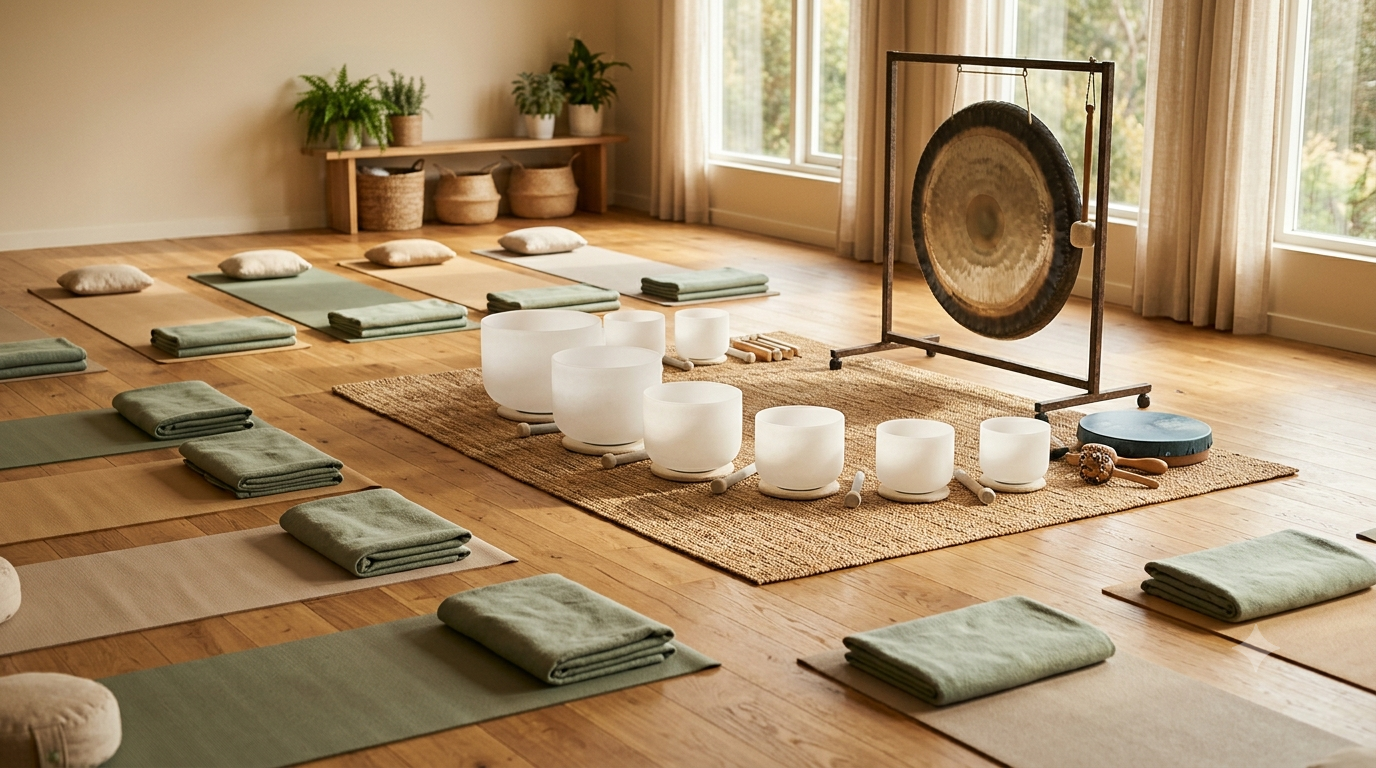
People picture a wall of exotic gear. My working kit is deliberately portable, because facility work means carrying your room with you: seven quartz crystal bowls, a gong, an ocean drum, and natural rattles.
Portability isn't a compromise, it's a design choice with a story behind it. The programs that need this work most are not spas. They're treatment centers where the session room is a converted office, the schedule is tight, and the practitioner who shows up with two car trips of equipment misses the setup window. Everything I own earns its place by what it does to a room per pound.
Each bowl is tuned to a note, and I compose sessions ascending the body: C for the root and its questions of safety and belonging, where recovery rooms need the most time, up through D, E, F, and G, to A at the third eye and B at the crown. The gong grounds, the ocean drum cleanses and gently provokes, and the bowls resolve. That order is the architecture of the hour, not a playlist.
The rattles are the detail people ask about. Used sparingly at transitions, natural rattle textures mark the passage from one stretch of the session to the next, the way a chapter break lets a reader breathe.
Where I learned to stand behind this practice
A word on where my confidence comes from, because in this field you should always ask.
I spent years working in a law firm, and I left that life in 2017 after these practices did for me what years of white-knuckled discipline couldn't. I came to the recovery field through my own family's story with alcoholism, which is why the treatment center rooms feel less like a market to me and more like a homecoming.
Since then the work has scaled the honest way: one facility at a time. My team presently runs more than 30 sessions a week across 11 locations with 20 facilitators and constantly growing, and the longest client relationship, with Aya Healthcare, has run since 2017. I say all this not as a brag sheet but as the answer to the only credential question that matters here: has this person done the hours in rooms like mine?
How sound healing works, honestly labeled
My working model has three layers, and I label each by how much evidence carries it.
Measured and published: an NIH-indexed study found singing bowl meditation significantly reduced tension, anger, fatigue, and depressed mood, with first-timers showing the biggest tension drop.
Early and exploratory: brainwave entrainment, the model where sustained resonant tone invites the brain from busy waking states toward the slower delta and theta territories of deep meditation and restorative rest. EEG researchers have begun testing it directly.
Practitioner's framework: my chakra-based composition method, ascending seven quartz bowls from root to crown, and the deliberate use of resonance to relax and dissonance to release. Quartz is piezoelectric and the body is mostly water, which is physics; how far the physics explains the felt experience is a question I hold with open hands.
My standing line with physicians: the science stops where the research stops, and you'll learn more in one hour on a mat than in every study currently published. The full mechanism story is in how sound healing works.
What people get out of it
The benefits sort cleanly by confidence, and I rank them that way on principle.
Strongest: deep relaxation, reduced tension and anxious mood, quieted racing thoughts, and unusually good sleep that night. In recovery populations, clients consistently report cravings going silent for the hour, which for someone whose mind hasn't been quiet in months is proof of concept, not a perk.
Real but subjective: colors behind closed eyes, dream-like states, emotional release, and occasionally profound experiences, including contact with people they've lost. I report those in the experiencer's own framing and attach no mechanism. A young man once rose from his first session having met the friend whose drowning he'd carried for years; he called that hour more progress than years of counseling on that wound.
And the honest boundary: sound healing cures nothing, promises nothing, and depends on willingness. The complete ranked tour, including who benefits most and how a director can measure it, is in sound bath benefits.
Who's on the mats
The practice travels across settings better than any other modality my team runs, and each room pays differently.
In addiction recovery and behavioral health programs, it's weekly infrastructure: the hour that regulates nervous systems working harder than anyone's, builds the routine clients organize their week around, and hands counselors a more available client. By week four, staff watch clients count down to session day, which is retention happening in real time.
In corporate settings, it's the pattern interrupt. I've played rooms of executives and rooms of physicians, including a Kaiser Permanente event with more than 150 doctors, and the most common report afterward is a shifted perspective. One neurologist left puzzling, happily, over why the sound made him see colors.
Staff rooms deserve their own mention. Clinical teams spend their days holding other people's crises, and facilities that book sessions for their own people, not just their clients, tell me it reaches morale in a way wellness stipends never did. An hour where nothing is asked of you is the rarest commodity in healthcare.
And in studios and retreats, it's the front door where most people first meet the practice, the way I did in the desert. Wherever you start, the hour is the same shape. What changes is the container, and reading the room in front of you is the craft.
The first session paradox
One thing I tell every new room, every new director, and now you, because managing this expectation is the difference between a program that survives week one and a program that doesn't.
The first session is often the hardest one. A nervous system that has spent years braced experiences the first loosening as more sensation, not less: restlessness, itchiness, an urge to check the clock. People in fresh detox and people carrying heavy trauma feel it most. Named in advance, it becomes tolerable; unnamed, it convinces people the practice isn't for them exactly one session before it starts working.
The trajectory after that is remarkably consistent. Week two settles faster. By weeks three and four, the same clients who couldn't close their eyes drop in within minutes of the gong, and the between-session effects arrive: better nights, quieter cravings, a calm with a longer half-life.
That's why every recommendation on this page assumes rhythm. A single session is a real experience. A weekly slot is a program, and programs are what change hallways.
The room matters as much as the instruments
The variable nobody budgets for is containment: the felt sense that the room is handled, so vigilance can clock out.
Dim light, spaced mats, a door that closes, a temperature on the warm side of neutral, and a facilitator who asks permission before burning anything fragrant. None of it is decor. Every element is a message to the oldest part of the brain that nothing here needs watching.
Studios get containment for free; facilities improvise. I've run beautiful sessions behind a hung curtain where a door should have been, and I've watched a single mid-session walk-through cost a room twenty minutes of settling. When I consult with operators, the room conversation comes before the calendar conversation, every time.
If you're hosting at home between sessions, the same principles scale down: headphones, a dim room, a body horizontal, a phone in another room. A recording delivers the tempo of the practice, though not the full-body resonance of live instruments, which no speaker reproduces.
What sound healing costs
Directors ask this first, so I answer it in public, which most providers won't.
Clinical sound healing sessions run 70 to 250 dollars per hour in the current market, with most experienced practitioners landing between 115 and 150. Where a quote falls in that range should track experience, population fluency, and reliability, not confidence alone.
Two pricing reads worth knowing. A quote dramatically above your own clinical pay scale tells you the provider has never worked inside an institution, because no facility pays an experiential provider far more than its therapists. And a quote with no answer for "what happens when your practitioner is sick" isn't a price, it's a hope. Coverage is what my team's model was built around, and it's the guarantee our references mention unprompted.
Finding a real practitioner
Skill in this craft is audible within a minute, if you know what to listen for.
I evaluate every bowl player on three Ps. Pressure: how the wand meets the bowl, since too much or too little ruins the tone. Placement: where on the bowl the wand rides. Pace: novices rush, and a rushed bowl sounds anxious to a room of resting nervous systems; trained players slow down and let each tone live its full life.
Beyond the instruments, I look for real training hours over weekend certificates, an active hosting practice, command of the room, and a calm voice offering words worth the silence they interrupt. For clinical work, add trauma capacity and population fluency, which is exactly what most facilities don't know to vet for.
The complete guide, red flags included, plus where to find my own team's public and facility sessions in Los Angeles, Orange County, and Bozeman, is in sound healing near me.
Bringing sound healing into a facility or workplace
If you run a program or a team, here's the short operational version.
You need a room with a door that closes, a protected weekly slot, and a practitioner matched to your population. You don't need belief, special equipment, or a renovation; my team carries the entire kit into converted offices every week.
Judge a pilot at week four, not day one. First sessions are often restless as braced nervous systems adjust; the signals that matter, unprompted attendance, calmer groups, clients asking when the next session is, arrive by the end of the first month.
And ask any provider, mine included, the two questions that separate programs from performances: who covers the session when your practitioner is out, and which directors at organizations like mine will take my call. My answers are a substitute bench that has never let a facility calendar go dark, and named references at Clear Behavioral Health, Kaiser Permanente, and Aya Healthcare, a partnership running since 2017.
My team delivers sessions in person across Los Angeles and Orange County and live online for teams and programs anywhere. If you want the version of this conversation that's specific to your population and your building, book a discovery call.
A 30-day pilot, step by step
For the operators reading, here's the plan I'd run in your building, whoever you hire.
Week zero: walk the facility and pick the room. Ask what it sounds like at 2 pm on a Tuesday, whether the door closes, and who might walk through mid-hour. Set your baseline while you're at it: this month's attendance patterns and the current tone of community meetings, written down, so week four has something honest to be compared against.
Week one: run the first session with the framing talk given full time, and expect restlessness. Brief your clinical team on the calendar so counselors mention the session in their own hours rather than scheduling over it. Buy-in from staff is the multiplier on everything that follows.
Weeks two and three: hold the slot exactly where it was. Same day, same hour, same room. Consistency is doing invisible work here; a slot that moves trains clients to disengage before the practice gets its fair test.
Week four: measure against the baseline. Unprompted attendance, counselor reports from the hour that follows the session, the hallway walk-out, and the one question worth asking clients directly: what do you look forward to this week. If the session makes that list unprompted, you're watching retention form.
Then decide with data instead of impressions. Programs that run this sequence almost never cancel, not because the practice is magic but because a fair four-week test surfaces what the first restless session hides.
One more piece of advice from the delivery side: give the program an internal owner. A protected slot with a named owner survives budget season and staff turnover; an orphaned one gets rescheduled into oblivion by everyone's good intentions. Hand your director of operations the provider's direct line and the pilot calendar, and the whole thing runs itself.
Nine posts into this library, the invitation hasn't changed: one hour, one mat, zero belief required. Book a discovery call and tell me who your people are.
Warmly,
Kara