I keep two explanations of how sound healing works, and which one you get depends on who's asking.
When a physician asks, I talk about resonant tones and the tension-and-release properties of dissonance, shifting brainwave states, dislodging emotional stagnation, synchronizing internal rhythms. When a client in detox asks, I say: the resonant sounds relax you, and the dissonant sounds create just enough tension to help something deep let go.
Both are true. Both are the same mechanism wearing different vocabulary. This post gives you the full version, including the parts I hold as a practitioner's working model rather than settled science, clearly labeled, because that honesty is the whole game in this field.
Sound healing works by giving the nervous system dense, resonant sound that's easy to rest inside and hard to think over. In my working model, the sustained tones encourage the brain to downshift from busy waking states toward the slower delta and theta states associated with deep relaxation, while moments of dissonance surface and release held tension. The result most people feel: quieted thinking, deep rest, and a body that finally stands down.
Here's that answer unpacked, layer by layer.
Start with the problem sound solves
To understand how sound healing works, start with what it's up against.
A stressed nervous system is a vigilance machine. It scans, braces, and narrates, and it does all three automatically, which is why telling an anxious person to relax achieves nothing. Vigilance doesn't take verbal instructions.
Stillness alone doesn't fix it either. Sit a wired person in a silent room and their thinking gets louder, which is why so many people fail at meditation and conclude something's wrong with them.
Sound healing solves the engagement problem. It gives the scanning mind something rich enough to occupy it and safe enough to require nothing back. The instruments hold attention the way weather holds attention: fully, and without asking you to do anything about it. Once attention is held and the body is horizontal, the downshift the nervous system has been refusing for months finally has room to happen.
The brainwave framework: waking states to delta and theta
Here's the centerpiece of my working model, in plain terms.
Your brain's electrical activity runs at different tempos depending on state. Alert, problem-solving wakefulness runs fast. Relaxed, reflective states run slower. Deep meditation, dream states, and restorative sleep run slower still, into the territories called theta and delta.
The premise of sound healing is that sustained resonant tone invites the brain toward those slower tempos, a process often called brainwave entrainment: rhythms in the environment nudging rhythms in the body toward synchrony. It's the same intuition behind why a lullaby works on an infant and why a room full of people breathes together during a gong wash.
My honest label for this: it's the framework I teach and compose sessions around, and early research is beginning to probe it directly. A small EEG study has examined whether singing bowl sound produces meditation-like brainwave changes in listeners, exactly the right question, still early in the answering. I present delta and theta as my map of the territory, drawn from years of watching rooms, and I'm comfortable saying the definitive brain-imaging atlas of a sound bath hasn't been written yet.
What has been measured is the outcome end. An NIH-indexed study of 62 adults found singing bowl meditation significantly reduced tension, anger, fatigue, and depressed mood. Whatever the full mechanism turns out to be, the exit surveys already agree with the mats.
Resonance relaxes, dissonance releases
If brainwaves are the tempo story, this is the texture story, and it's the part most explanations of sound healing skip entirely.
Resonant, consonant tones are the welcome mat. They're why the gong opens my sessions: a sound so large and grounding that the body stops waiting for a threat and settles into what's already here.
Dissonance is the working tool. Played deliberately, two near-clashing tones create a subtle tension in the listener, and that tension finds whatever the body is already holding. This is the stretch of a session where restlessness can surface, and it's supposed to. Tension that surfaces inside a safe, held hour gets to release; tension that stays buried just keeps running the machine.
Skilled practitioners use near-dissonant bowl pairs, F and G for instance, to create a beating, transporting effect between two tones. Amateur players avoid dissonance because it sounds wrong to them; trained ones deploy it the way a masseuse finds the knot. The difference between those two players is one of the three Ps I vet every facilitator on, and it's audible within a minute.
The full session arc, gong to ocean drum to twenty minutes of crystal bowls, sequences these two forces deliberately: ground first, provoke gently in the middle, resolve into the deepest rest at the end. That architecture is documented step by step in what is a sound bath.
The nervous system half of the story
Brainwaves are one lens. The nervous system is the other, and for the populations my team serves, it's the more practical one.
I teach a simple two-state framework. The fearful state is the contracted one: short shallow breath, narrowed attention, a body braced for the next thing. The expanded state is its opposite: long easy breath, wide attention, a body that has concluded, for now, that it's safe. Stress, trauma, and addiction all train a person to live in the first state and forget the second one exists.
Sound healing works on that forgetting. An hour inside resonant sound is an extended, embodied argument that the expanded state is still available, made to the body directly rather than to the mind.
The breath deepens on its own. The scanning quiets on its own. Nobody talks themselves into it, which is precisely why it reaches people that advice has never reached.
This is also why I call the practice nervous system training rather than entertainment. Each session rehearses the downshift, and rehearsal is how a nervous system learns anything.
One caution belongs here, and it's the reason first sessions can feel paradoxical. A system that has been braced for years sometimes experiences the first loosening as more agitation, not less: restlessness, itchiness, an urge to bolt. I frame it before every session, because named in advance it becomes tolerable, and on its far side is the release everyone came for.
Why live sound reaches deeper than a recording
People ask whether a recording with headphones does the same job, and the honest answer is: partially.
A recording delivers the tempo story. Your brain will still slow toward rest inside sustained tone, which is why I do recommend recorded bowls between live sessions for people building a practice.
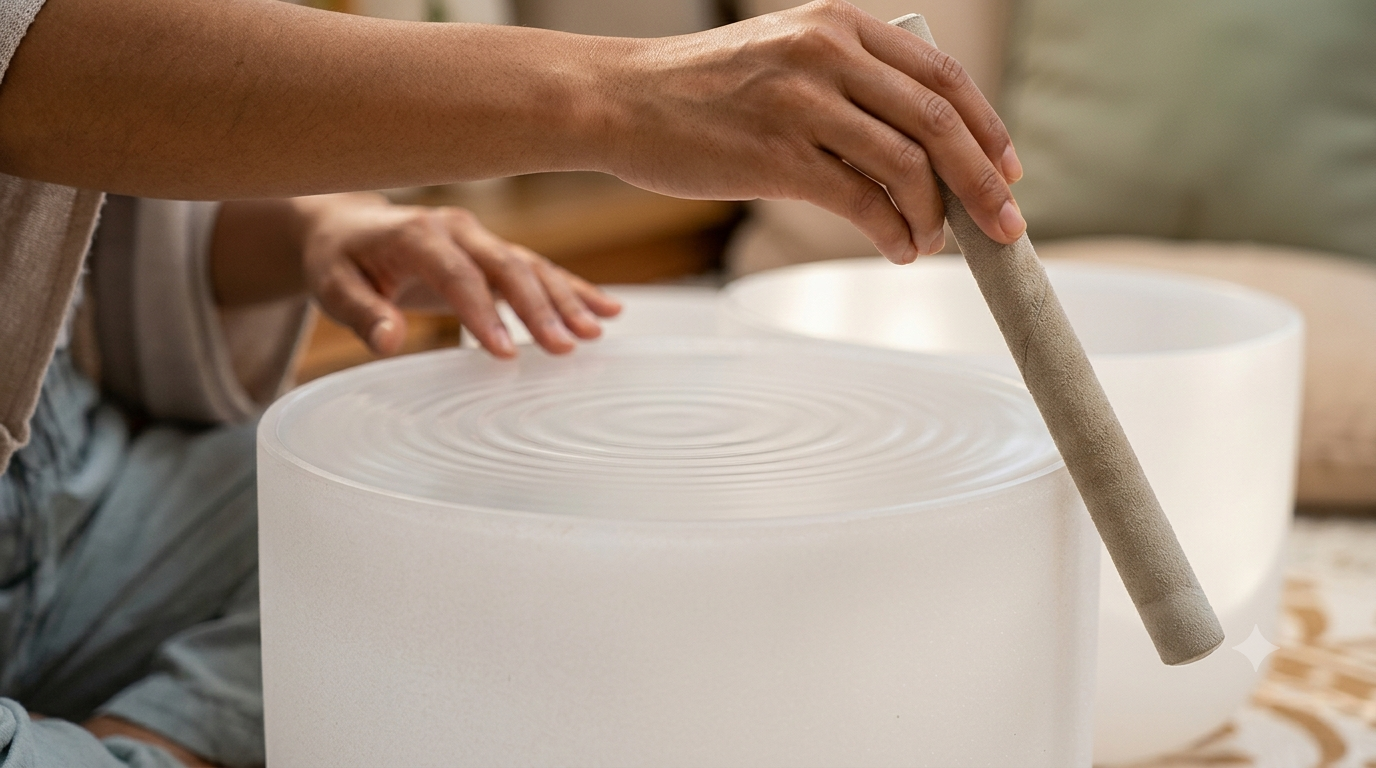
What a recording can't deliver is the physical half. In a live room, the sound arrives through the air and through the floor, and a body that's mostly water conducts that vibration through tissue, not just eardrum. A gong wash is something you feel in your sternum. No speaker in your budget reproduces that, and the deepest session states, in my experience, ride on exactly that full-body resonance.
Live also means a practitioner reading the room in real time: staying longer in grounding tones when a group runs anxious, softening the dissonant stretch for a fresh detox cohort. A recording plays the same hour to every nervous system. A practitioner plays the room in front of her.
Why the bowls are tuned the way they are
Each of my seven quartz crystal bowls is tuned to a note, and I compose sessions ascending from the root of the body to the crown.
C serves the root: safety, grounding, belonging, and in recovery rooms I stay here longest, because safety is the prerequisite for everything else. D serves the sacral center: creativity and relation. E serves the solar plexus: identity and personal power, tender territory in early recovery. F serves the heart, G the throat and voice, A the third eye, and B the crown.
Two honest labels on this. First, the chakra map is a practitioner's framework with thousands of years of contemplative history behind it, not a claim I ask the research to carry. Second, quartz itself brings physical properties worth naming: it's piezoelectric, converting pressure into electrical energy, and the body it plays to is mostly water, a superb conductor of vibration. Where those facts end and the felt experience begins is exactly the kind of question I love and won't pretend is answered.
What I can tell you from the delivery side: the ascent works. Rooms track it, even rooms full of people who've never heard the word chakra, and the deepest releases cluster reliably in the upper keys, the same stretch where the young man in what is sound healing met his drowned friend and put down years of guilt.
What it looks like from the outside
Here's the strange part, and I tell every facility director this before their first observation: from the outside, almost nothing appears to happen.
Sixty people lie still for an hour. The visible events are small: occasional twitching as tension discharges, diaphragms pulsing as breath deepens, hands slowly curling open. A clipboard observer would record stillness and write down "nap."
The event is internal, and the after-picture is where it shows. People stand up looking taller, happier, often younger, the visible signature of held tension leaving faces and shoulders. Then come the reports: colors, dream states, quieted cravings, the first real rest in weeks.
That gap between how little it looks like and how much it does is why I invite skeptical directors to participate rather than observe. Observation measures the wrong side of the skin.
It's also why session photos undersell this work so badly. Every marketing image of a sound bath looks like a nap class, and every exit conversation sounds like something else entirely. If you're evaluating providers, weigh the exit conversations.
The mechanism trains: week one to week four
If the model above is right, sound healing shouldn't just work once. It should work better with repetition, the way any rehearsed downshift does. That's exactly what I watch in treatment programs, on a timeline consistent enough to schedule around.
Week one is the noisy one. New clients fidget, check the room, and sometimes meet that paradoxical restlessness as years of bracing start to loosen. A few fall asleep out of sheer exhaustion, which I count as a win.
Week two, the room settles faster. Bodies that learned last week that nothing bad happens here stop spending the first twenty minutes confirming it.
By weeks three and four, the change is unmistakable. Clients settle within minutes of the gong, drop into the deeper states the bowls are built for, and start reporting the between-session effects: better nights, quieter cravings, a calm that outlasts the hour. Staff see it from their side as unprompted attendance and clients asking when the next session is.
That trajectory is the practical proof of mechanism, and it's why I tell directors to judge a pilot at week four, not day one. A parlor trick performs the same every time. A training effect compounds, and compounding is what this practice does when it's given a protected weekly slot.
Where the science honestly stops
I've labeled my claims all the way down this post, so let me put the summary in one place, because this is the paragraph that earns or loses a skeptical reader.
Measured and published: significant reductions in tension, anger, fatigue, and depressed mood after singing bowl meditation, with first-timers showing the largest tension drops. Early and exploratory: EEG work on whether bowls produce meditation-like brainwave changes. Practitioner's framework, held with confidence and open hands: the delta-theta downshift model, the resonance-dissonance architecture, and the chakra composition map.
My line with physicians hasn't changed: the science stops where the research stops, and research funding lags decades behind practice here. When 150-plus doctors at a Kaiser Permanente event experienced this work, the neurologist who saw colors didn't need me to fake a mechanism for him. He needed me to be exact about what's known, what's suspected, and what's simply witnessed, week after week, in rooms I'm accountable for.
That's the standard I hold this whole field to, and it's why the practice keeps earning weekly slots inside evidence-minded institutions. The outcomes side of that story, ranked benefit by benefit, is in sound bath benefits, and the full operator's guide lives at sound healing therapy.
If you want to feel the mechanism instead of reading it, that takes one hour and zero belief. Book a discovery call and I'll point your team or your program to the right first session.
Warmly,
Kara