My first sound bath was at the Integratron, a mysterious, other-worldly dome just outside Joshua Tree, California.
I walked in a curious skeptic and walked out changed enough to eventually build a career around what happened in that room. Years later, I've led hundreds of these sessions, in studios, in corporate offices, and every week inside addiction recovery and mental health programs.
So when someone asks me what a sound bath is, I don't reach for mystique. I walk them through the hour, minute by minute, because the honest walkthrough is more persuasive than any brochure language, and because knowing what's coming is half of what lets a nervous system relax.
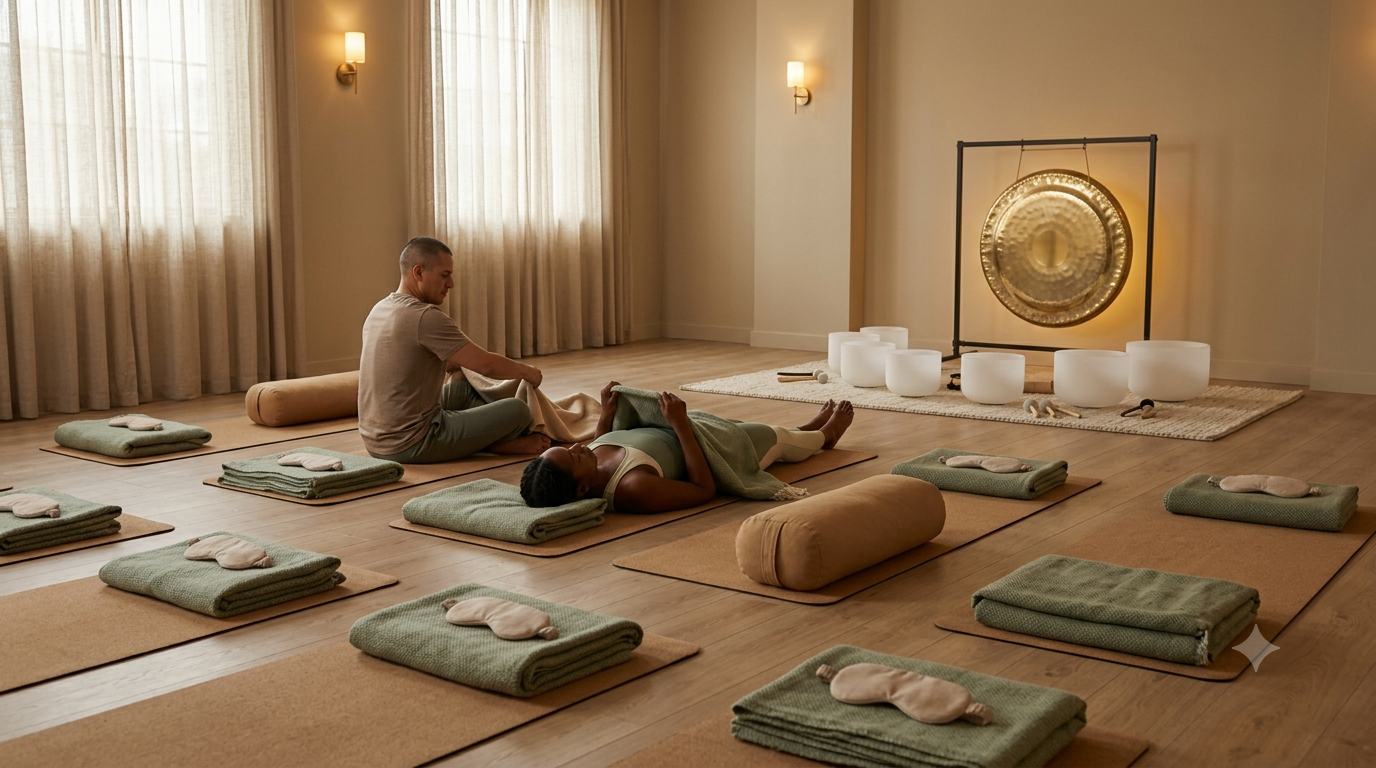
A sound bath is a guided, roughly 60-minute session in which you lie down, fully clothed and comfortable, while a practitioner plays resonant instruments, typically gong, drums, and quartz crystal bowls, over and around the group. There's no touching, no movement required, and nothing to do but rest and listen while the sound guides your body into deep relaxation. Sound bath and sound healing are two names for the same practice.
One more reassurance before the tour, for the nervous first-timer, because I meet you at every session. You cannot do this wrong.
You can't be bad at lying down. Falling asleep isn't failure, fidgeting isn't failure, and a mind that narrates the whole hour still gets the physiological benefit of an hour of resonance and rest. The people most convinced they'll be terrible at this are routinely the ones who float out of the room an hour later asking when the next one is.
Here's the full tour, exactly the way I run it.
The room, before you arrive
A good sound bath starts before the first note, in decisions you'll never consciously notice.
The lights are dimmed. Mats are spaced so nobody's arm is in a stranger's territory, each with a blanket and a bolster. In bespoke settings I put out eye masks. The temperature runs neutral to warm, because an hour of stillness under sound waves gets chilly faster than people expect.
If I use incense, sage, or palo santo, I ask the room's permission first. Sensitive noses are common, and consent over scent is a small thing that tells the group how the whole hour will treat them.
None of this is atmosphere for its own sake. It's containment: the felt sense that this room is handled, so your vigilance can clock out. In treatment facilities, where a converted office with a curtain sometimes stands in for a studio, protecting containment is the difference between a session that works and one that doesn't, which is why my sound healing therapy hub talks about rooms as much as instruments.
The talk before the sound
I never start cold. The few minutes of framing at the top are, I'd argue, the most clinically important part of the hour.
I tell people what instruments they'll hear and in what order, so nothing startles. I preview the range of normal experiences: deep relaxation, sleep, colors, vivid imagery, memories surfacing, and sometimes restlessness.
That last one gets special handling. I explain that sound loosens stored tension, and the first thing loosening can feel like is more tension: agitation, itchiness, the urge to open your eyes and check the room. If that rises, breathe through it and let it pass. It's tension surfacing on its way out, not something going wrong.
Then the instruction, which fits in one breath: close your eyes, open your ears, connect to your breath. That's the whole job description. People who've spent years failing at meditation are visibly relieved to hear it.
The hour itself: a sound bath from the inside
Here's the arc of a 60-minute session, the same shape whether I'm at a wellness studio or a detox unit.
The first seven to ten minutes are guided settling. Shake out the limbs, soften the jaw and the tongue, a few long exhales through the mouth. The mouth exhale matters; it's the fastest downshift signal the breath can send.
Then the gong, for about seven minutes. It's grounding, resonant, and oddly reassuring, a sound large enough that the body gives up scanning for anything else.
Then the ocean drum, another seven or so. It sounds like whitewater and rain, cleansing, and sometimes deliberately provoking. This is where surfacing tension tends to show itself, right where I told people it might.
Then the crystal bowls, the heart of the session, roughly twenty minutes carrying us to about minute forty-five. Their circular, lyric tones are nearly impossible to think over, and this is where the deepest states arrive: the visions, the dream-like drifts, the resolutions people carry out of the room.
The return takes three to five minutes and I never rush it. Wiggle fingers and toes, knees to chest, a gentle rock, over to the fetal position, then up to seated. Coming back is part of the practice, not the end of it.
I close every session the same way, hands at heart center, a deep breath in, suspended, folded hands to the third eye, and the same words: a blessing that you'll be guided by intuition and have the wisdom and the courage to follow it. A bow. Namaste.
The talking after: where the session pays off
After the closing, I open space for reflection, and this is the part first-timers don't expect and facilities come to prize.
If the group is shy, I seed it with a topic matched to the room. With corporate teams: stress and what self-care actually looks like on a Tuesday. In addiction recovery: the transition into the sober self, what you're keeping and what you're letting go. In behavioral health programs: how your perspective has shifted between the day you arrived and now.
What comes out ranges from "I fell asleep and it was the best nap of my year" to things that stop the room. People describe healings and epiphanies. Relief from anxiety and compulsive thinking. Colors, out-of-body experiences, contact with people they've lost.
I hold all of it the same way: as each person's own experience, in their own framing, without pushing an explanation on anyone. Whatever happened for you is right. The body self-heals when given the conditions, the frequencies accelerate the process, and over-analyzing the experience, or making it wrong, is the only real mistake available.
And sometimes the honest report is restlessness, especially from people in fresh detox or carrying heavy trauma. An overstimulated nervous system takes time to trust stillness. I tell those clients the truth: week one is the hardest one, and it gets easier every single week after.
What I'm doing while you rest
People assume the practitioner's hour is simple: play the instruments, keep the order. The instruments are maybe half of it.
The other half is reading the room with my eyes and ears the whole time. Breathing patterns tell me when a group has dropped in. A hand curling, a diaphragm pulsing, the small twitches of release tell me someone's process is moving and the pacing should hold steady rather than advance. Restlessness in one corner tells me to stay longer with the grounding tones before I lift into the higher keys.
Pace is the discipline. The novice mistake in this craft is rushing, and a rushed bowl sounds anxious, which a room full of resting nervous systems absorbs instantly. Experienced players slow down, let each tone finish its full life, and choose complementary keys deliberately. I evaluate every facilitator on my team against exactly these fundamentals before they ever set foot in a facility.
Voice belongs on the list too. The words at the top and the guidance at the return have to be worth the silence they interrupt. Shallow scripts read as shallow even to people with their eyes closed, and a calm, unhurried voice is itself an instrument.
None of this is visible from the mats, which is the point. When the hour feels effortless to you, that's the craft working.
What a sound bath is not
The name invites confusion, so let me clear the three most common mix-ups before they cost you a booking.
There's no water. You'll be bathed in sound, not anything wet, and you stay fully clothed on a mat the entire time. At least once a month someone asks, and I'd rather answer here than at the door.
It's not a concert. A performance asks for your attention; a sound bath asks for your surrender. The instruments aren't playing songs, they're producing sustained resonance designed for a resting body, which is why lying down with eyes closed gets you a categorically different experience than sitting and watching.
And it's not therapy. A sound bath is an experiential wellness practice led by a certified practitioner, and in treatment settings it runs alongside clinical care as support, never as a substitute. That boundary protects everyone, and any practitioner who blurs it is telling you something important about their judgment.
While I'm at it: it isn't religious, either. The experience is acoustic and physiological. Plenty of people meet something meaningful in it, and the room holds that without requiring any belief from the mat next to them.
How often should you take a sound bath?
A single session gives most people a genuinely restorative hour, and for a first-timer that's the right goal: go once, notice what shifts.
The compounding happens with rhythm. Weekly is the cadence I recommend and the one my facility programs run, because the nervous system learns the route. Regulars settle within minutes of the gong, drop deeper, and carry the calm further into their week than any single session can reach.
There's research texture behind the first-timer experience too. An observational study of singing bowl meditation found participants reported significantly less tension, anger, fatigue, and low mood after a session, and first-timers showed the biggest tension drop of anyone. Beginners aren't at a disadvantage in this practice. They're the ones with the most to release.
If you're building the habit at home between sessions, even ten minutes of recorded bowls with headphones helps hold the ground, though nothing replicates a live room's physical resonance.
What to wear and bring to a sound bath
The practical part, short and complete.
Wear soft, loose, breathable clothing you could nap in. Bring or borrow a sweater and socks, because still bodies cool down. If low backs complain, a bolster under the knees fixes most of it, and I keep extras on hand.
An eye mask is optional and lovely. Beyond that, bring nothing. No experience, no flexibility, no belief system, no ability to quiet your mind. The instruments handle the quieting; that's their whole job, and it's why this practice reaches people that seated meditation has repeatedly failed.
If you can't attend in person, live online sessions work far better than most people expect. The instruments carry, the arc is the same, and our virtual programs run them for teams and programs anywhere.
The same hour, in a treatment program
Everything above describes the practice anywhere. Here's what changes when the sound bath moves inside a treatment center, which is where my team spends most of its week.
At a studio, everyone chose to be there and probably has a wellness practice already. In a facility, attendance is often required programming, and some clients were enrolled by family or a court order. Willingness, the single most important variable in this work, can't be assumed. It has to be earned in the first ten minutes, which is why the framing talk gets even more care there.
The room changes too. Studios were built for this; facilities improvise, and I've run sessions behind a hung curtain where a door should have been. It works, but every compromise in containment costs something, so part of my job is teaching operators what the room needs before the first session ever runs.
What doesn't change is the arc, the instruments, or the closing blessing. Clients in treatment get the same hour a luxury spa gets. Watching a group of people in early recovery receive that, many for the first time in their lives, is the part of this work I'd do for free.
Staff notice the difference in the hallway afterward. Clients walk out looking taller, happier, often younger, the visible signature of held tension letting go, and counselors tell me the following clinical hour lands differently.
For what the practice actually does over weeks, the honest evidence picture lives in sound bath benefits, and the mechanism story, delta and theta states included, is in how sound healing works.
One hour, nothing required of you, and a nervous system that finally gets to stand down. If you want that hour for your team or your facility, book a discovery call and tell me about the room you have.
Warmly,
Kara