Here's an uncomfortable truth about the search you just ran: the results are ranked by marketing budget, not by skill.
Sound healing has boomed, and the boom brought in everyone: gifted practitioners with a decade of hours, and people who bought bowls online last spring and a certificate the weekend after. Both groups have websites. Both charge money. And from the outside, before the first note, they look identical.
I train and vet facilitators for a living, my team runs weekly sessions inside treatment programs across Los Angeles and Orange County, and I've auditioned more bowl players than I can count. So instead of a directory, I'm going to give you the evaluator's toolkit: exactly what I listen for, what I check before anyone touches my clients, and the red flags that end an audition early.
Searching for sound healing near me? Skip the ads and vet for three things: real training hours (100-plus, in person, not a weekend certificate), an active practice you can verify (regular public sessions, a real web presence, references), and skill you can hear, which shows up in the pressure, placement, and pace of their bowl play. If a practitioner can't hold a room, command their instruments, and say honestly what the practice does and doesn't do, keep looking.
Here's how to run that vetting yourself.
Start with the three Ps: skill you can hear
Instrument skill in this craft is audible within a minute, and you don't need to be a musician to hear it. I evaluate every player on three Ps.
Pressure. The wand has to meet the bowl with exactly enough force. Too much and the tone turns harsh and metallic; too little and it stutters and dies. A skilled player draws a tone that blooms and sustains.
Placement. Where the wand rides on the bowl matters. Too high and it lifts off and skips; too low and it scrapes, a jarring sound your body registers even with eyes closed.
Pace. This is the big one, because it's psychological, not mechanical. Novices rush, and a rushed bowl sounds anxious, which a room full of resting nervous systems absorbs instantly. Trained players slow down, let each tone finish its full life, and trust the silence between notes.
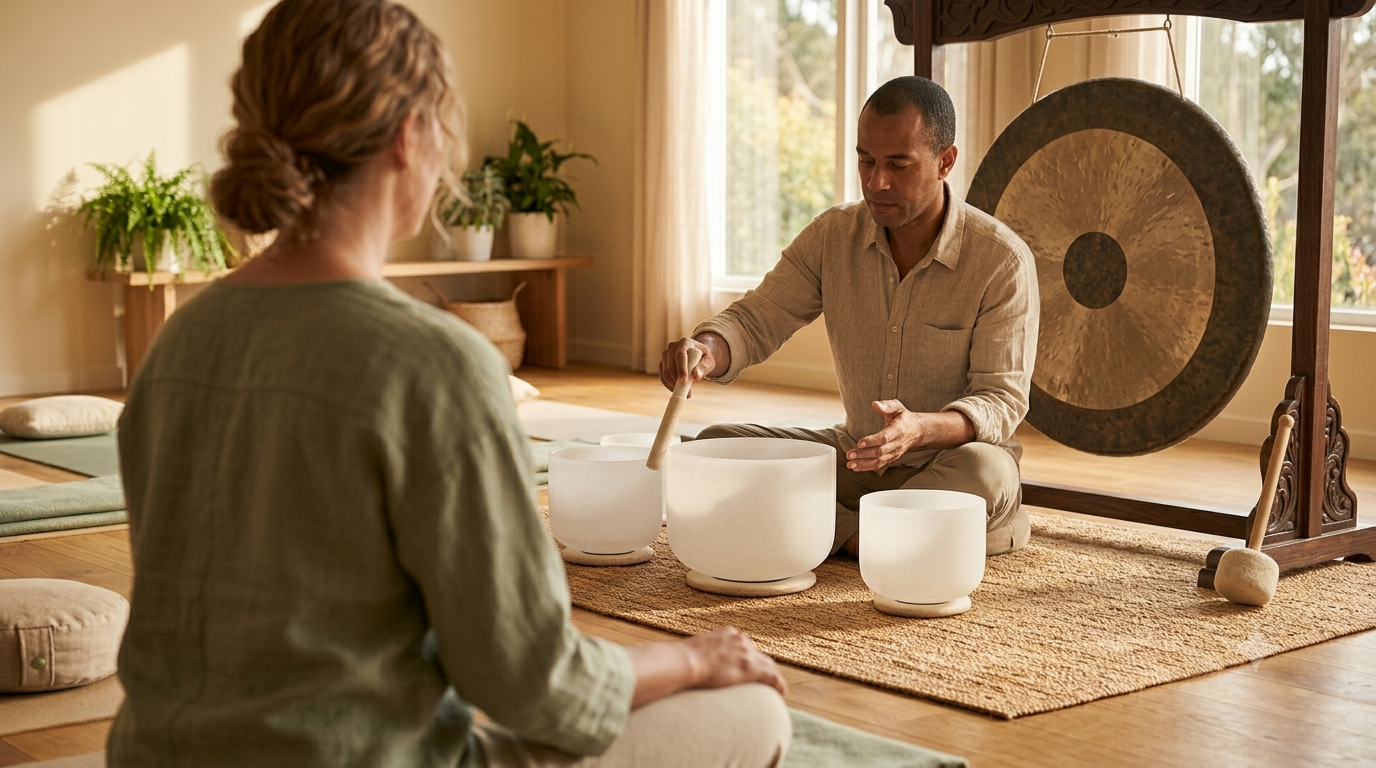
Beyond the three Ps, experienced practitioners run multiple bowls in deliberate combinations, know which keys complement each other, and use near-dissonant pairs, F and G for instance, to create a beating, transporting effect between two tones. If you attend one public session as an audition, listen for exactly these things.
Check the training, and don't be shy about it
Certification in this field is unregulated, which means the word certified tells you almost nothing by itself. Ask two questions instead.
How many training hours, and were they in person? A 20-hour online certificate makes someone a beginner; I'd audition and coach that person, not put them in front of a recovery group. In-person training beats online across every modality I hire for, because this craft is about reading bodies in a room, which no video course teaches. One hundred plus hours, along with real musicianship, is where I start taking a resume seriously.
Do they have an active practice? Regular public sessions you could attend this month, a web presence that looks maintained, and people who will vouch for them. A practitioner with skill has a trail. A practitioner without one has a story.
For clinical and workplace settings, add the layer most people never think to check: population fluency. Holding a room of studio regulars is one skill. Holding a detox cohort, a dual diagnosis group, or 150 skeptical physicians is another, and the practitioner who has only done the first will drown in the second. My full breakdown of what this work looks like inside facilities is in what is a sound bath.
What a real sound healing session should feel like
Since the audition and the benefit are the same hour, you should know what good feels like from the inside.
A well-run sound healing session starts before the sound: dim light, spaced mats, a blanket, and a practitioner who tells you exactly what instruments are coming and what experiences are normal, including the restlessness some first-timers feel as held tension starts to loosen. That framing talk is a skill marker in itself. Amateurs skip it; professionals know it's half the hour's safety.
Then the practice does its quiet work. Most people feel progressively heavier, many fall asleep, and research backs the felt shift: an NIH-indexed study of singing bowl meditation found significant reductions in tension, anger, fatigue, and low mood after a single session, with first-timers showing the biggest tension drop of anyone.
The exit is the test I trust most. A skilled practitioner returns you slowly, holds a little space for reflection, and sends you out more regulated than you arrived: softer face, longer breath, quieter head. If you walk out feeling rushed, jangled, or performed at, the search continues, whatever the website said.
Studio, home, workplace, or facility: matching the setting to the search
The phrase near me hides four different searches, and the right answer differs by which one is yours.
If you're an individual looking for a public session, a studio or wellness space is the front door. You get purpose-built containment and a shared-cost price, and one visit doubles as your practitioner audition.
If you want sound healing at home, between sessions or instead of them, recordings with headphones in a dim room hold real ground, though they deliver the tempo of the practice without the full-body resonance of live instruments. I recommend recorded bowls as a bridge, not a destination.
If you're booking for a workplace, prioritize practitioners with corporate fluency: rooms of professionals need a different framing talk than studio regulars, and the reflection window works best seeded with the right topic. My team's most requested corporate format is a monthly session paired with a short teaching segment.
And if you're a treatment program, everything in the next section is for you, because your version of this search carries clinical stakes the other three don't.
The red flags that end my auditions
The negative signals matter as much as the positive ones, so here's my actual disqualification list.
They can't command the space. Confidence in front of a resting room is a skill; a practitioner who seems nervous, apologetic, or scattered transfers exactly that state to the mats.
The environment is wrong. Noisy, unclean, unsafe, or chaotic settings tell you how they'll treat your room. Containment is half this craft, and someone who doesn't protect it doesn't understand the work.
The instrument play is poor. Three Ps, audible in the first minutes.
The words are shallow. The talking at the top and the guidance at the close should be worth the silence they interrupt. Scripts recited without presence read as hollow even to people with their eyes closed.
And the claims are inflated. Anyone promising cures, guaranteed outcomes, or medical results is selling something the practice can't deliver. The honest version, what research supports and where it stops, lives in how sound healing works, and a practitioner who won't give you that honest version is disqualified on character, not just accuracy.
One more, specific to facilities: a solo practitioner with no coverage plan. However gifted, one human being cannot guarantee their own flu schedule, and a program that goes dark every time one person travels isn't a program. It's a gamble with your calendar.
Why facilities shouldn't run this search alone
If you're a director or operations lead who typed sound healing near me on behalf of a treatment center or a company, I'll say plainly what the search results won't.
You're not equipped to vet this, and that's not an insult. It's a category problem. Everything above, the three Ps, training-hour standards, trauma capacity, population fit, is specialist knowledge from a field with no licensing board. Facilities know how to credential a therapist; there's no equivalent rubric for this work, which is exactly how weak practitioners end up in strong programs.
That gap is the reason my company exists. When my team places a facilitator, the vetting is already done: online presence reviewed, purpose and orientation toward service screened, experience matched to your region and population, interviews passed, contracts and certifications verified, insurance confirmed, and full client onboarding completed, physicals and TB tests included, before anyone sets foot in your building.
And the coverage problem is solved structurally. Multiple vetted facilitators per region, cross-briefed, under one agreement, so a sick day on our side never becomes a dark hour on your calendar. That guarantee is the thing our facility references mention without being asked.
The economics of a managed team surprise people too. You're not paying a premium over a strong independent; you're paying a comparable session rate, published openly in my sound healing therapy guide, for a program instead of a person.
The question underneath the search
One more reframe before the directory part, because it changes how you evaluate everyone, including me.
Most people searching sound healing near me think they're shopping for an event: one lovely hour, hopefully nearby, hopefully soon. The people who get the most from this practice are actually shopping for a rhythm, whether they know it yet or not.
A single sound healing session is a real experience, and for a first visit that's the right goal. The compounding effects, faster settling, deeper states, calm that survives into the workweek, arrive with regularity, which is why my facility calendars run weekly and my corporate clients book monthly at minimum.
So as you vet practitioners, add one forward-looking question to the list: is this someone I could sit with regularly? Proximity genuinely matters for that answer, more than it does for a one-off, which makes your near me instinct exactly right. You're not looking for the best session within driving distance. You're looking for the best practice you'll actually keep.
Where to find my team
The honest disclosure in a post like this: when people ask me where to find great sessions, I point them to my own team, because vetting practitioners is literally my job. Here's where we are.
Los Angeles, Ventura and Orange County are home turf. My facilitators run weekly sessions inside addiction recovery and mental health programs across these counties, from the South Bay and West LA through the Valleys to North OC, and we deliver corporate sessions, workshops, and retreat programming across the same footprint.
Bozeman, Montana is my second base, where I teach and run sessions including my work with Montana State University students. If you're in the Gallatin Valley, reach out and I'll point you to what's current.
A note on why you won't find a public schedule of our facility sessions: those run inside client treatment programs and are open to their clients only, which protects the containment that makes the sessions work. It's also why the public calendar breathes month to month around program commitments. The trade-off is the one I'd want from any provider: the rooms come first.
Everywhere else, there's the version most people don't expect to work: live online sessions. The instruments carry beautifully, the arc is identical, and teams from anywhere join through our virtual programs. It's how organizations outside Southern California run weekly programming with us.
For individuals, the fastest route is simply to get in touch and ask what's open to the public this month; sessions inside client facilities aren't public, so the public calendar shifts. For organizations, the same link books a discovery call, and twenty minutes usually answers everything this post raised about your specific building.
If you're auditioning someone else this week
Go to the public session before you book the private one. Arrive with the three Ps in your ear and the red-flag list in your pocket.
Then ask the practitioner three things afterward. Where did you train and for how many hours? What happens in your sessions when someone gets restless or emotional? And what does this practice not do?
The first answer tells you their foundation, the second their trauma capacity, and the third their honesty.
Trust what you heard and felt over what the website promised. A real practitioner leaves you more regulated than they found you, and you'll know within one hour. That's the beautiful thing about this field: the audition and the benefit are the same event, and the ranked tour of what that benefit looks like is in sound bath benefits.
The practitioner you want is the one who'd pass every test on this page and invite the scrutiny. Reach out and I'll point you to a session, ours or the right fit for where you are.
Warmly,
Kara