When a clinical director is deciding whether to give me a weekly slot, the real question under all the polite ones is simple: what will my people actually get out of this?
I love that question. It deserves a better answer than the internet gives it.
Search for sound bath benefits and you'll find pages claiming everything from cured insomnia to realigned cells. Some of those claims make me wince, and I run these sessions for a living. So here's my version: every benefit I'm willing to put my name to, ranked by how much I'd stake on it, with the research where research exists and honest labels where it doesn't.
The sound bath benefits with the strongest support are reduced tension and anxious mood, deep relaxation, quieted racing thoughts, and better sleep that night. Peer-reviewed research on singing bowl meditation backs the tension and mood effects. Reported experiences like vivid imagery and emotional release are common but subjective, and no honest practitioner claims a sound bath cures any condition.
Let's take it from the top of the confidence ladder.
The benefits I'd stake my name on
These are the outcomes I observe in nearly every session, across every population I serve, from detox units to boardrooms.
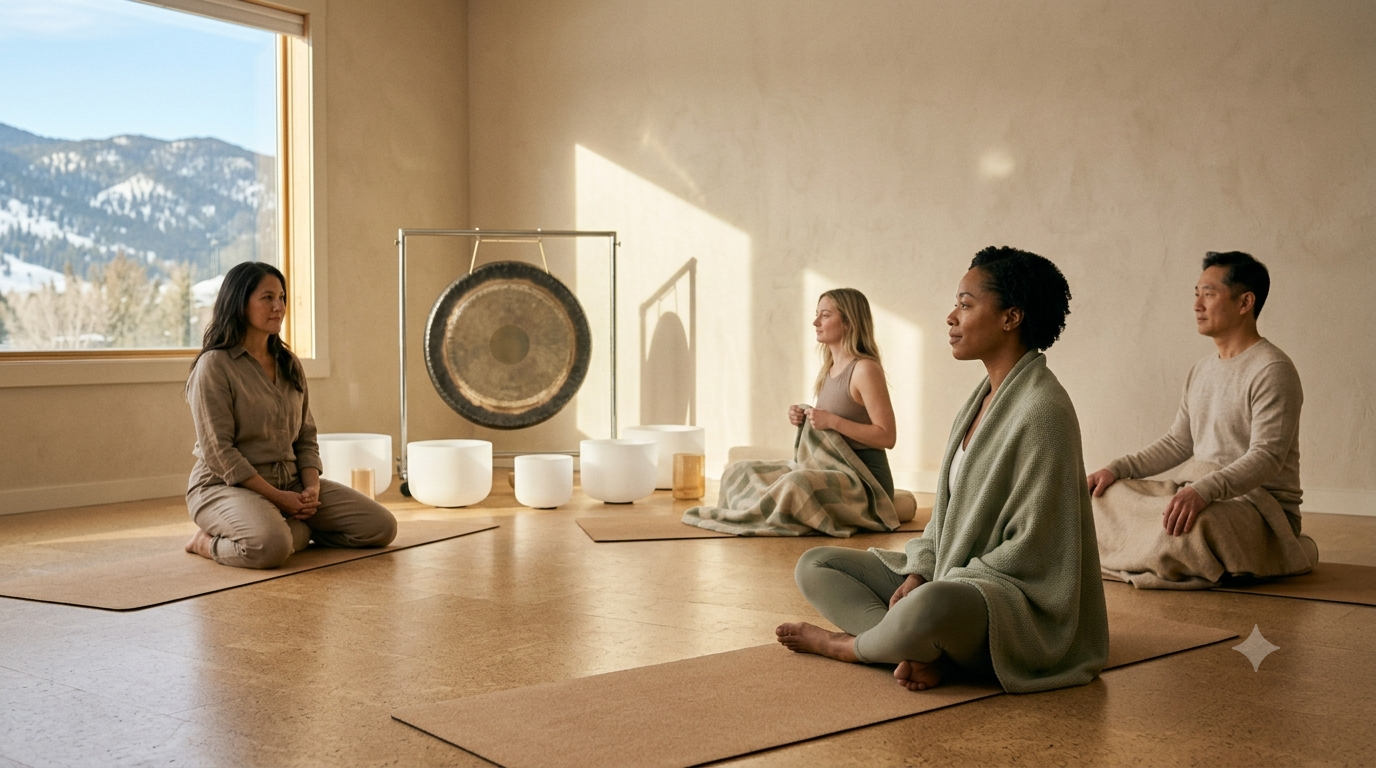
Deep relaxation is the headline, and it's not a vague word here. I mean the visible, physiological downshift: slowed breath, softened faces, limbs gone heavy. The most common outcome in my rooms is that people fall asleep, and when they apologize I tell them what I always tell them. You got exactly what you needed.
Tension and mood have actual research behind them. An NIH-indexed observational study of 62 adults found singing bowl meditation significantly reduced tension, anger, fatigue, and depressed mood, with the largest tension drop in first-timers. One study doesn't make a science, and its authors say more research is needed. But it says plainly that people leave these sessions measurably less wound up than they arrived.
The quieting of compulsive thinking is the benefit I consider most underrated. The bowls' circular, lyric tones are genuinely hard to think over, and participants routinely report that racing thoughts, and in recovery populations, cravings, went silent for the hour. For someone whose mind hasn't been quiet in months, that silence isn't a nicety. It's proof of concept that their own system can still do it.
And then there's the night after. Presence, a settled sense of well-being, and the best sleep in recent memory come up so consistently in next-day reports that I now tell first-timers to expect it.
A detail worth naming about that sleep: it isn't the collapse of exhaustion, it's the sleep of a system that finally stopped bracing. Clients describe waking up without the usual first-thing dread, and in treatment settings, night staff sometimes notice the difference on the unit before anyone files a report. One quiet evening isn't a clinical outcome, but stack them weekly and you're looking at the floor a recovery gets built on.
What the research is starting to add
The evidence base here is early, and I'd rather show you its actual edges than round up.
The singing bowl study above is the strongest single piece: real reductions in tension, anger, fatigue, and low mood, measured with validated scales, published in a peer-reviewed journal. Its honest limits: modest size, no control group, and self-reported outcomes.
Researchers have also begun measuring brainwave activity in listeners during bowl sessions, early work exploring whether the sound nudges the brain toward meditative states. I find it promising and I cite it carefully, as exploration rather than proof. The mechanism story, including the delta and theta framing I use, lives in how sound healing works.
My standing line with physicians applies here: the science stops where the research stops. Research funding lags decades behind practice in this field. That's a reason for humility in claims, not a reason to discard a practice whose results you can observe in one hour.
The reported experiences, held honestly
Beyond the measurable outcomes sits a category I refuse to oversell or dismiss: what participants tell me happened to them in there.
People report seeing colors with their eyes closed. Dream-like states and vivid imagery. Emotional releases that arrive without warning and leave people lighter. Occasionally, experiences of contact with people they've lost, like the young man whose story anchors what is sound healing, who called one hour more progress on his grief than years of counseling.
I publish these as what they are: subjective experiences, in the experiencers' own framing, consistent across years and populations. They're not claims about mechanism. They're data about what human beings report when their nervous systems finally stand down, and for many participants they're the most valuable thing the practice gives.
In treatment programs there's a version I watch for specifically. Clients in the darkest early stretch describe sensing light or warmth arriving, an opening out of the darkness of the addiction. When a client meets that in week two of treatment, their counselor has something real to work with in week three.
The benefits nobody should promise you
Here's the section that gets me the trust of skeptical directors, because it's the one the sales pages skip.
A sound bath doesn't cure anything. Not addiction, not depression, not insomnia as a condition. In clinical settings it's an experiential wellness service that supports treatment, and the research language for practices like it is consistent: promising adjunct, not replacement. Anyone selling it as a standalone cure is selling something.
The benefits also depend on willingness. A person forced onto a mat with arms crossed gets less than a person who chose to lie down, which is why organizational buy-in matters so much in facilities. I name willingness as the strongest variable in this work, and I'd rather lose a sale than hide it.
Results vary by nervous system, and the first session especially. People in fresh detox or carrying heavy trauma sometimes spend hour one restless as loosening tension surfaces. That's not a failed session; it's week one of a process that reliably eases by week three or four.
And my honest population limit: teens. My results with adolescents are mixed, because asking a fifteen-year-old to stay present for an hour of stillness is a genuinely hard ask. Adults, including highly skeptical ones, are this practice's natural audience.
Who benefits most
After hundreds of sessions, I can sketch the people who walk out most changed.
First-timers, delightfully, and the research agrees: the biggest measured tension drops in that singing bowl study were in people new to the practice. If you've never done this, you're not behind. You're holding the most releasable tension in the room.
High-functioning stressed professionals, the ones running on vigilance, are the second group. This includes clinical staff, and facilities increasingly book sessions for their teams, not just their clients. I've watched rooms of physicians, 150-plus at one Kaiser Permanente event, arrive as the most evidence-trained skeptics I serve and leave with a grounded presence they didn't walk in with. The most common corporate report afterward is a shifted perspective, which sounds soft until you watch it change how a team talks to each other.
And people in early recovery, the population my team serves most. Their nervous systems are working harder than anyone's, cravings hijack their quiet moments, and an hour of enforced rest they don't have to earn is often the first bodily proof that calm is still available to them. Clear Behavioral Health's regional director, whose programs we serve weekly, credits the sessions with a visible positive impact on their wellness programming, and that's the kind of benefit report I value most: from the people who watch the hallway afterward.
The same sound bath, different rooms
Benefit lists flatten something important: the same hour pays different populations differently. Here's what I actually watch land, room by room.
In corporate settings, the sound bath functions as a pattern interrupt for teams running on vigilance. The benefit people name afterward is perspective: the problem they walked in chewing looks different from a regulated body. Managers book the next quarter's session before the blankets are folded, which tells you what the spreadsheet won't.
For healthcare and clinical staff, the benefit is nearer to triage. These are people who spend their days holding other people's crises, and an hour where nothing is asked of them is so rare that the room sometimes goes emotional before the gong finishes. Facilities that run a staff sound bath alongside client programming report it helps morale in ways their wellness stipends never touched.
In residential treatment, the benefit stack is the deepest. Early recovery bodies are exhausted, sleep-starved, and craving-hijacked, so the quieted thinking and the night of real sleep after a sound bath do disproportionate work. Add the weekly rhythm effect, clients settling faster each session, and the hour becomes a fixed point clients organize their week around.
And in outpatient programs, where clients juggle treatment with jobs and families, the benefit that matters is transferability. The session teaches their body what down-regulated feels like, which gives their breathwork and meditation practices a felt target for the other six days.
Same instruments, same arc, four different returns on the hour. That's why my team composes every sound bath for the specific room rather than running one script everywhere.
How a director can measure it
If you're evaluating a sound bath program for a facility, don't take my word list on faith. Measure it in your own building over a month.
Watch attendance without prompting: who shows up to an optional session by week four. Ask counselors what they notice in the clinical hour that follows the session. Watch the walk-out: faces, shoulders, the hallway noise level. And ask clients one question, what do you look forward to this week, then count how often the session makes the list.
Those are retention signals wearing wellness clothing, and they're the reason experiential programming survives budget season in the facilities that measure it.
One more measurement tip from years of watching programs get evaluated: set the baseline before the first session, not after. Note this month's attendance patterns and the tone of your community meetings now, so week four has something honest to be compared against. Programs that skip the baseline end up arguing from impressions, and impressions lose to budget spreadsheets every time.
Getting the benefits to compound
One session is real. A rhythm is where the practice earns its budget line.
Weekly cadence is what I recommend and what my facility calendars run. Nervous systems learn the route: regulars settle faster, drop deeper, and carry the calm further into the week. By week four, staff tell me clients are asking when the next session is, and unprompted attendance is the retention signal every director recognizes.
If you're building the habit personally, a live session weekly or biweekly with recorded bowls between visits holds the ground well. If you're building it for an organization, the full walkthrough of the hour is in what is a sound bath, and the operator's guide to the whole practice lives at sound healing therapy.
Why the benefits arrive without belief
One objection deserves its own section, because it's the one the skeptics in my rooms are silently holding: isn't this all just placebo for people who already believe in it?
It's a fair question, and my answer starts with who's on the mats. My weekly rooms aren't self-selected wellness enthusiasts. They're court-ordered clients, exhausted nurses, and physicians who came because their department booked the hour.
Belief is not the common denominator in those rooms. The downshift happens anyway.
The reason is that the primary benefits are physiological before they're psychological. An hour of stillness, slowed breathing, and dense resonant sound gives the nervous system conditions it responds to mechanically, the way your heart rate responds to a hill whether or not you believe in hills. Expectation surely colors the experience, as it colors every human experience. It isn't carrying the load.
My favorite evidence is the reluctant participant arc, which I've watched hundreds of times. Arms crossed at the door, eyes open through the gong, and then somewhere in the bowls the body simply outvotes the argument. Those participants often give the most striking reports afterward, precisely because nothing in them was trying to have an experience.
So no, you don't need to believe anything for a sound bath to lower your idle. You need an hour, a mat, and a practitioner who knows what they're doing. Bring the skepticism. It rests as well as everything else does.
The benefit that sells the second sound bath is the first one. If you want your team or your program to feel it, book a discovery call or see how our virtual programs bring the sound bath to you, wherever your people are.
Warmly,
Kara