A young man rose from his mat in tears, and not the kind you worry about.
He was new to the facility, somewhere between eighteen and twenty, curious but completely new to this work. He'd stayed still through the entire session. Afterward he told the group that years of counseling hadn't touched the grief and guilt he carried from watching a friend drown.
During the highest keys, the smallest bowls, she came to him. She reassured him she was okay, that she didn't hold him responsible, that she was happy. He called that hour more progress than years of talk on that one wound.
I'm not going to explain that experience away, and I'm not going to dress it up as science either. I'm going to do what I do at the start of every session: tell you plainly what sound healing is, what it isn't, and what tends to happen when a room full of nervous systems lies down inside sound.
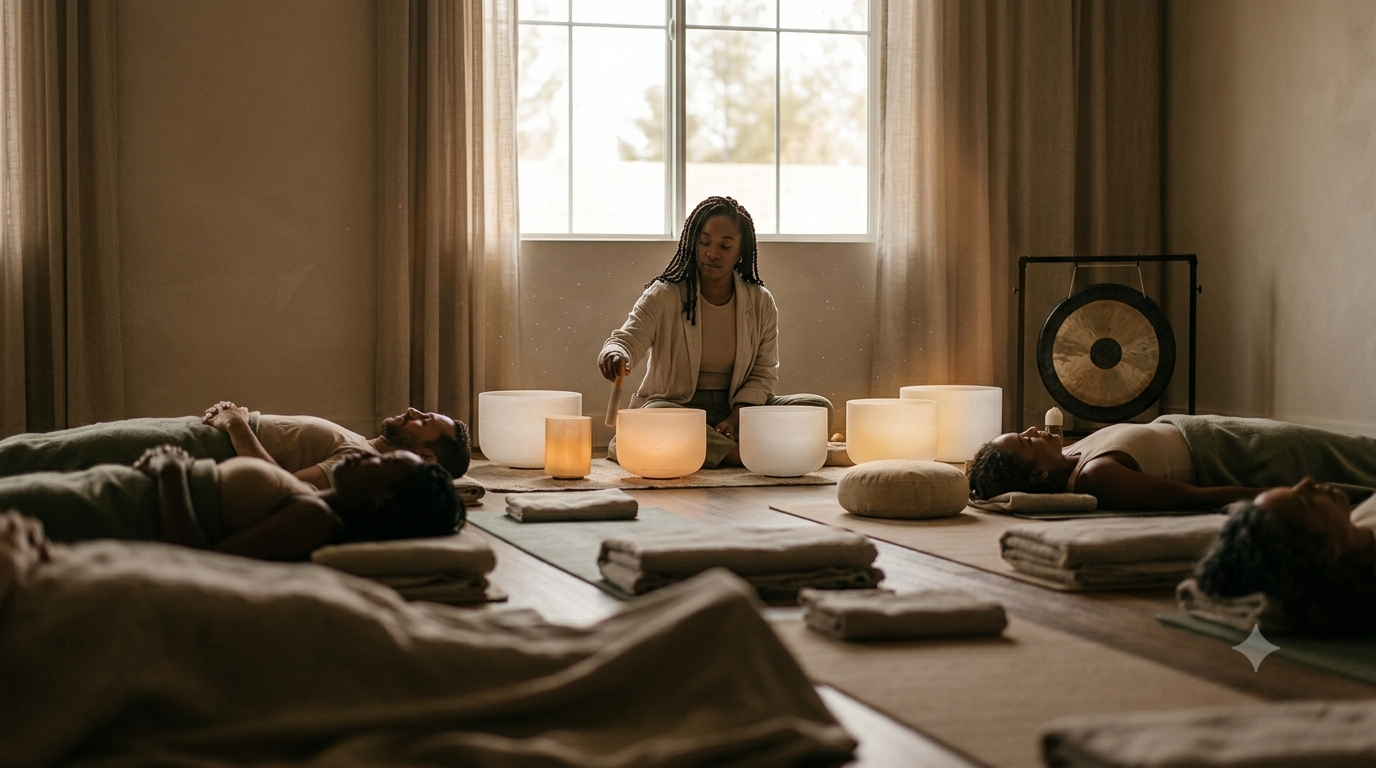
Sound healing is the use of resonant instruments, quartz crystal bowls, Tibetan bowls, gongs, chimes, and drums, to guide a state of deep relaxation, support nervous system regulation, and put the body and mind into a passive state where the self-healing process can occur on multiple levels: physical, mental, emotional, energetic, and spiritual. You'll also hear it called a sound bath; the two terms describe the same practice.
That definition is mine, built from years of weekly sessions, and every phrase in it is doing a job. Let me unpack the ones that matter most.
Sound healing, sound bath, sound therapy: which words mean what
Two of these terms are interchangeable and one is commonly misused, and the difference is worth thirty seconds because it will change what you search for and who you book.
Sound healing and sound bath mean the same thing: a facilitated session where instruments are played over and around resting participants. If you want the blow-by-blow of what a session looks like, I've written that separately in what is a sound bath, and the umbrella guide to the whole practice lives at sound healing therapy.
Sound therapy is different, and people misuse it as a synonym constantly. In its proper sense, sound therapy usually refers to auditory rehabilitation, clinical work for compromised hearing and auditory processing. If you book "sound therapy" expecting bowls and a blanket, or book a sound bath expecting audiology, somebody leaves confused.
One more boundary I hold carefully because my team works inside treatment programs. Sound healing is an experiential wellness service, delivered by certified practitioners to support relaxation and regulation. It is not psychotherapy, and a practitioner should never present it as treatment for a diagnosis. In clinical settings it runs alongside therapy, never instead of it.
What actually happens in the body
Here's the frame I give skeptical directors and curious first-timers alike.
Your nervous system spends most of its day scanning and bracing. Stress, trauma, and addiction all crank that vigilance higher, and no amount of being told to relax talks it down, because vigilance doesn't live in the thinking mind.
Resonant sound gives the system something it can't get from conversation: input that's rich enough to hold attention and safe enough to require nothing. You lie down. The instruments do the reaching. Thinking quiets because the sound is circular and lyric and hard for the mind to narrate over.
That's also why the first session isn't always blissful, and I'd rather tell you now than let it surprise you. Sound loosens stored tension, and for highly stressed or traumatized people the first thing loosening feels like is more awareness of the tension: restlessness, agitation, an urge to check the clock. I teach people to breathe through that surfacing and let it pass, because on the other side of it is the deep release everyone comes for.
How deep? The most common outcome in my rooms is that people fall asleep. When they apologize afterward, I tell them the truth: you got exactly what you needed.
The instruments, and why the order matters
People imagine a sound healing kit as a wall of exotic gear. Mine packs into a car, deliberately, because facility work means carrying your room with you: seven quartz crystal bowls, a gong, an ocean drum, and natural rattles.
The order they play in isn't decoration. It's the architecture of the hour.
The gong opens the session. Its resonance is grounding and strangely reassuring, a sound big enough that the body stops waiting for something to happen and settles into what already is.
The ocean drum comes second, and it's the honest one. It sounds like whitewater and rain, cleansing and occasionally provoking on purpose, because this is the stretch where surfacing tension tends to show itself. I tell people beforehand: if restlessness rises here, breathe through it and let it pass.
The crystal bowls close the arc, usually about twenty minutes of them. Their circular, lyric tones are the part of the session that impedes thinking in the best way, and it's where the deepest visions and resolutions tend to happen, including the young man's reunion that opened this piece.
Each bowl is tuned to a note I map to one of the body's energy centers, ascending from root to crown. That mapping is my practitioner's framework, refined over years of watching what different keys do to a room, and I compose each session for the population lying in front of me.
What the research says, and where it stops
I hold a rule about evidence that some practitioners in my field dislike: say what the research supports, and stop.
There is real, peer-reviewed support here. An observational study of 62 adults published in an NIH-indexed journal found that singing bowl sound meditation significantly reduced tension, anger, fatigue, and depressed mood, with first-timers showing the largest drop in tension. The authors' own conclusion is appropriately modest: a feasible, low-cost intervention for tension and low mood, worth further study.
For the quartz side of my kit, I stand by the framing I've published before. Quartz is piezoelectric, meaning it converts pressure into electrical energy, and the body is largely water, a superb conductor of vibration. Those are physical facts.
How far they explain what happens on the mats is a live question, and I treat my chakra-based composition method as a practitioner's framework, not a lab finding. Dr. Kulreet Chaudhary's book Sound Medicine is where I point people who want the researcher's view of this territory.
While I'm being precise, a word about the word healing, because it makes some evidence-minded readers bristle. I keep it, deliberately, but I define it narrowly: the body's own self-repair process, the one that already knits your skin and settles your heart rate, given quieter conditions to work in.
The claim is not that sound fixes you. The claim is that a deeply rested, regulated state is where self-repair does its best work, and that resonant sound is one of the most reliable ways I know to produce that state in a room full of strangers. Everything beyond that, I hold with open hands.
Beyond that, my honest line is the one I use with physicians: the science stops where the research stops. Research interest and funding lag decades behind practice in this field. You will gain more understanding from participating in one session than from reading every study that currently exists, and I say that as someone who reads the studies.
What people report, in their own framing
Now the part I refuse to sand down, because it's real data from real rooms, even though it isn't laboratory data.
Across hundreds of sessions, people report seeing colors with their eyes closed. Profound dream-like states. Visions and out-of-body experiences.
Some report premonitions. And some, like the young man at the top of this piece, describe contact with people they've lost.
I report these as what they are: subjective experiences, described by the people who had them, consistent enough across years and populations that I stopped being surprised. I don't assert a mechanism for them. The people who have them rarely need one.
In recovery populations there's a motif I've come to watch for. Clients in the darkest stretch of early treatment describe sensing light or warmth arriving, what one client called an opportunity to come out from the darkness of the addiction. Whatever framework you hold, something in the deeper self seems to wake up and start guiding, and a wise program gives that awakening a weekly appointment.
The gentler, more common reports matter just as much to the people who run facilities: relief from anxiety, the first unbroken sleep in weeks, and the cessation of compulsive thinking, including cravings, for the duration of the session and often the evening after. The full tour of outcomes, with the honest caveats, is in sound bath benefits.
Who it's for, and the screening truth
In my practice I've never turned someone away from a sound session, and that includes rooms full of people in detox, dual diagnosis programs, and corporate teams who arrived rolling their eyes.
The one accommodation I make regularly is for sound-sensitive participants, often neurodivergent clients: earplugs or a spot farther from the instruments. I've done it many times and it works.
Two honest boundaries. First, this practice asks for willingness; a person forced onto a mat gets less from it, which is why buy-in matters so much in facilities. Second, I'm a practitioner, not your clinician: if you're managing a medical or psychiatric condition and unsure whether deep-relaxation work fits right now, that's a conversation for your treatment team, and I'll happily coordinate with them.
One pattern belongs here because it answers the question underneath the question. People who try a single session usually get a good hour. People who attend weekly get something better: the nervous system learns the route.
I watch it happen in treatment programs on a schedule you could set a clock by. Week one is fidgety. By week three or four, the same clients who couldn't close their eyes settle within minutes of the gong, because their bodies now know where this hour goes. Frequency, not intensity, is where this practice compounds.
Everyone else needs exactly nothing. No experience, no flexibility, no belief. You lie down and the sound does the reaching.
Skeptics make excellent participants, and honestly, some of my best rooms have been the reluctant ones. My favorite line for them hasn't changed: participate once and witness your own shift. It's undeniable.
Where sound healing runs, and who leads it
The setting changes more than people expect, and it's become a specialty of mine.
At a studio or spa, everyone chose to be there, most have wellness practices already, and the room was built for containment. Inside a treatment program, attendance is often required programming, some clients were enrolled by family or a court, and the session might run in a converted office with a curtain where a door should be. Same instruments, completely different job.
That's why who leads it matters. A practitioner working clinical rooms needs trauma capacity, population fluency, and the ability to hold a group that didn't ask to be there, on top of instrument skill. My standards for that, including the three Ps I use to evaluate bowl players, are their own post in this cluster.
The corporate version of the skeptical room deserves a mention, because it taught me how little belief this work requires. I've led sound healing for rooms of physicians, including a Kaiser Permanente event with more than 150 doctors, the most evidence-trained audience I've ever set bowls in front of.
The resistance was mostly in the arriving. Those who participated left with a grounded, shifted presence they did not walk in with, and one neurologist told me afterward, with genuine puzzlement, that he couldn't think of a reason the sound made him see colors.
I didn't hand him a mechanism. I handed him what I hand everyone: the experience itself, and the honesty that some of what happens in these rooms is still ahead of the research.
My team delivers sound healing two ways: in person across Los Angeles and Orange County facilities, and live online for teams and programs anywhere. If you're exploring either, our virtual programs page shows how the remote version works, and it works better than most people expect.
And if you're a director reading this on behalf of a facility, the operational questions you're already forming, who's vetted, what a weekly calendar costs, what happens when a facilitator is sick, are exactly the ones my team was built to answer. That conversation takes twenty minutes and usually saves a quarter of trial and error.
Ready to feel what a room full of quiet nervous systems is like? Book a discovery call and I'll point you to the right first session, in person or online.
Warmly,
Kara