There's almost always someone in the back row who hasn't moved in four minutes.
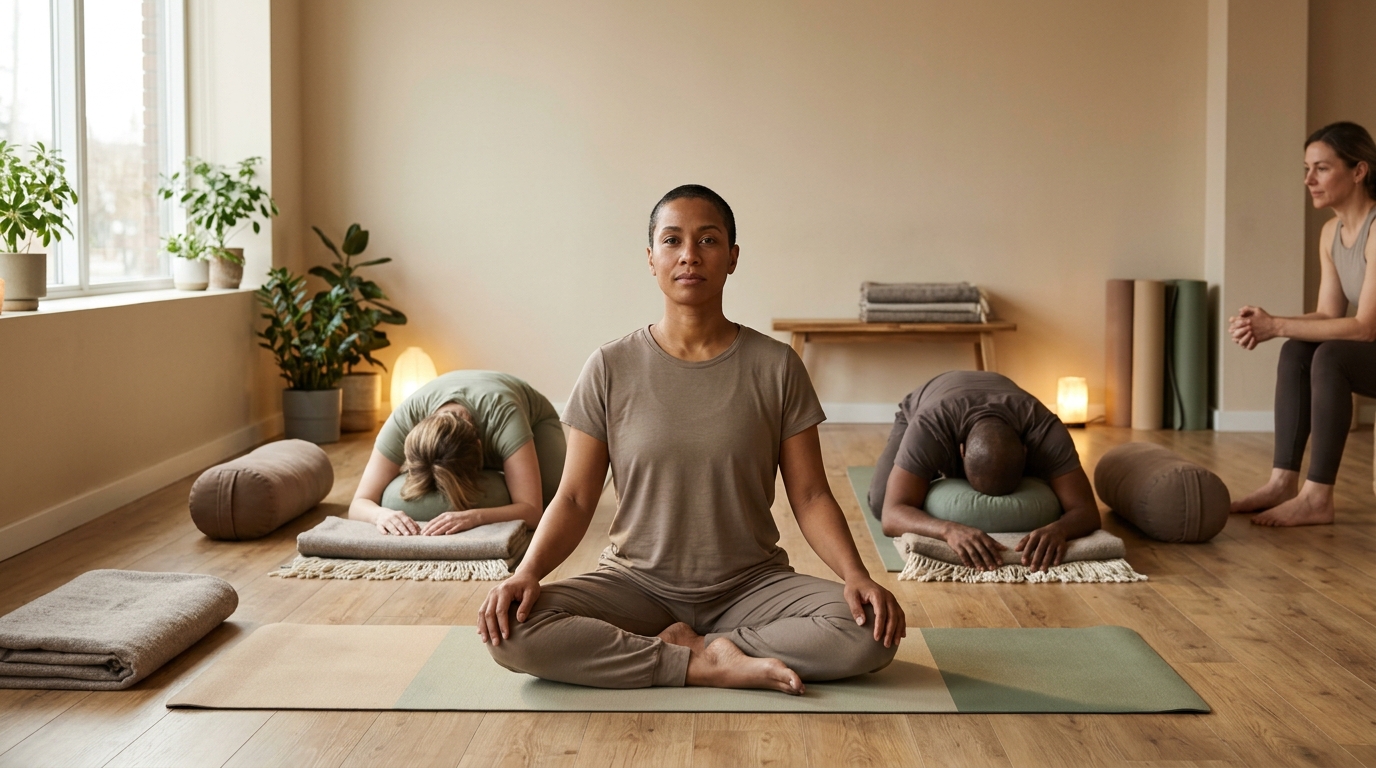
Everyone else is in supported pigeon, bolsters and blankets everywhere. He's sitting up, hands on his knees, eyes open, watching the door.
I know that posture. He's not resisting the class. He's doing the only thing his body will let him do right now, which is stay ready.
If you searched for yoga for trauma release, you probably found a list of poses. Pigeon for the hips. Child's pose. Bridge. The lists aren't wrong about the shapes. They're wrong about what does the work.
I'm a 500-hour ERYT, and practitioners in our network lead more than 35 trauma-informed sessions a week across treatment center locations. I've watched a lot of people arrive braced and leave softer, and the pose was rarely the reason.
Yoga can support trauma release, but the pose isn't what releases it. Release happens when the nervous system feels safe enough to stop bracing, and held tension lets go on its own. Choice, unhurried pace, plenty of props, and a teacher who can hold whatever surfaces do that work. Pushing someone into an open, vulnerable shape before they feel safe tends to do the opposite.
Does yoga release trauma?
Yes, and it's worth being precise about what that means.
Trauma release in yoga is the moment the nervous system feels safe enough to stop bracing, and tension the body has been holding lets go without being forced.
Sometimes it looks like tears. More often it looks like a long exhale someone didn't plan, or a person who came in guarded lying down in savasana for the first time in three weeks.
Trauma-sensitive yoga has been studied as a complementary treatment for PTSD, and Cleveland Clinic describes it as helping people slow down, notice what's happening in the body, and reduce symptoms. The research is real and still growing. Anyone who tells you yoga is a guaranteed cure for trauma is selling something.
What I can tell you from the room is narrower. The body doesn't let go because you told it to. It lets go when it stops expecting harm.
How does yoga release trauma? The mechanism is choice, not shape
The nervous system has two broad settings that matter here. One is protection, the fight or flight state where muscles brace, breath shortens, and attention scans for danger. The other is rest and repair.
Trauma, especially trauma that was done to the body, teaches the nervous system to live in protection. People dissociate from a body that felt like the scene of the crime. Embodiment, the slow return of awareness to physical sensation, is the reverse, and a lot of the people I work with lost access to it long ago.
So the question is never which pose. The question is what lets this particular nervous system feel safe enough to come back into the body for a few minutes.
Choice does more of that work than anything else. When a person knows they can stay seated while the room goes into downward dog, and nobody will make it wrong, something relaxes before they've moved. A relaxed body releases far more easily than a tense one. Choice comes first. Release follows.
That's also why I'm careful with the three things that push a body into vulnerability fastest: legs open, heart open, eyes closed. Each one is a request to lower a defense. Ask for all three before someone is ready and you've recreated the exact condition their body learned to brace against. It's the mechanism side of nervous system regulation, and it applies in every room.
Is trauma really stored in the hips?
The hips do hold tension. Hip openers can bring up emotion, and the pelvis and low belly, first and second chakra territory, is where a lot of people carry fear and shame. Supported pigeon is one of the two poses I reach for most, so I'm not dismissing it.
Here's where the listicles go wrong. They treat the hip as a container and the pose as a key. That framing quietly tells people that if they just push a little deeper, the release will come.
It won't. Or worse, something will come too fast, in a room that isn't set up to hold it.
The hips don't store trauma the way a drawer stores socks. What they store is bracing, years of it, and when a person finally feels safe enough to stop, the hips are often where you see it first.
The release isn't in the stretch. The stretch is where the release shows up.
Which yoga poses help with trauma release?
Since people search for yoga poses for trauma release, here are the ones I actually use in trauma release yoga. Every one is an invitation, never an instruction.
Child's pose. The most reassuring shape in the practice. The front body is protected, the eyes are naturally down, and nobody can see your face. When a student needs to opt out of anything, this is where I invite them.
Supported pigeon. Bolster under the front hip, blanket under the front knee, forehead on stacked hands or a block. The support matters more than the depth. This is where held emotion in the hips tends to surface, so it's also where I watch most closely.
Legs up the wall. Low effort, nothing to perform, and the body reads it as rest almost immediately.
Savasana, with options. Flat on the back with eyes closed is the most vulnerable shape in yoga. So I offer a bolster under the knees, legs up the wall, lying on the side with a bolster between the legs, or staying seated with eyes open. Whatever lets a person rest without feeling exposed.
Yin-style long holds. People on forums recommend yin yoga for trauma release, and there's something to it. Longer holds give the nervous system time to decide it's safe. Pushed to the edge in a vulnerable shape, though, slow is not the same as gentle.
No hero pose, no deep backbend. The shapes are quiet on purpose.
Which poses should be avoided in trauma-informed yoga?
Inversions, handstands, headstands, and deep backbends are extremely disorienting, and people rarely feel safe in them without years of practice. Where safety is the whole point, disorientation is the wrong tool. I always arrive with inviting alternatives prepared.
Eyes closed is the one that surprises new teachers. For a person carrying trauma, closing their eyes in a group can feel like giving up the one defense they trust. I offer it. I never insist.
Touch is the same. My hands don't go on anyone without asking and hearing yes. Consent isn't a policy in a trauma-informed room. It's the practice.
What a release actually looks like in the room
People picture sobbing. That happens, and it's fine when it does. What I see more often is smaller.
The first audible sigh of relief mid-practice. The reluctant student who hasn't moved for two classes and then, in the third, quietly folds forward. The man watching the door finally closing his eyes for ten seconds.
Willingness to participate is the metric I track week to week, because willingness is what a body does when it stops expecting harm.
What should a teacher do when someone cries or freezes?
Not fix it. When something bigger surfaces, tears, shaking, freezing, someone getting up to leave, I don't spotlight the person. I quietly check whether they want support, then give them the freedom and the dignity to have their own experience in its fullness without making it wrong.
Room size makes this possible. I keep trauma-informed classes to five to seven people, never more than ten. You cannot hold space you can't see.
And there's a line I say in every class, because it's the whole practice in one sentence:
"This is your class. I am here merely offering suggestions."
If you prefer to be in child's pose while the room is in down dog, do that. That freedom is the release.
Yoga for trauma release vs somatic therapy: where the line is
Trauma-informed yoga is a body-based practice led by a yoga teacher trained to hold space for people carrying trauma. Somatic therapy is clinical work done by a licensed therapist, and it can go places a yoga class should not. If you have acute or complex trauma, you want both, and the clinician leads. A yoga teacher who tells you otherwise is out of their lane.
When we refer practitioners into treatment programs, the minimum for our network is a 200-hour ERYT with at least two years of related experience and trauma-informed training. Some practitioners in our network have considerably more. If you're vetting a teacher yourself, I've written about what trauma-informed really means and how to check for it. Two red flags: any dissociating substance used during practice, and hands-on contact without consent.
Not sure you're ready for a group? Start with a private session, or watch a video of a trauma-informed class first, so your body knows what it's walking into.
How is trauma-informed yoga different from a regular class?
From the student's side, three things change. The pace is slower. Postures are held longer. And there are props everywhere, because comfort is what lets a body surrender.
From the teacher's side, everything changes: language becomes invitational and choice gets built into every cue. More on what trauma-informed yoga is, what a good trauma-informed yoga class looks like, and the hub on trauma-informed yoga.
One more thing, and I know it splits the room. Hot, fast, loud yoga with acrobatic sequencing disintegrates most of the benefit for a traumatized nervous system. Great workout. Not this.
| Pose-first yoga | Safety-first, trauma-informed yoga | |
|---|---|---|
| What releases trauma | The stretch | Felt safety; the stretch is where it shows up |
| Cueing | Instruction | Invitation, with an out every time |
| Pace | Flow | Slow, long holds |
| Props | Optional | Abundant, offered before asked |
| Eyes | Closed by default | Open unless the student chooses otherwise |
| Touch | Adjustments as standard | Consent asked and heard first |
| Group size | Whatever fits | Five to seven, never more than ten |
| When someone cries | Attention | Quiet check, then dignity and space |
What to take from this
If you came here looking for the pose that releases trauma, I hope you'll leave with something more useful: your body already knows how to let go, and it will, the moment it stops expecting harm.
That's the whole skill. Make the room safe, offer shapes instead of demanding them, and get out of the way when the release comes.
Give it a few weeks and the man in the back row is in child's pose, eyes closed, breathing slowly, nobody watching. That's what it looks like when it works.
If you're carrying trauma, find a teacher who runs a small room, offers you a way out of every pose, and asks before touching you. If you're bringing yoga for trauma release to people in your care, the teacher's capacity to hold what surfaces matters more than their sequence sheet.
Bringing trauma-informed yoga into a treatment program
This is what Coliberation Wellness does. We connect treatment centers and clinical programs with vetted, independent practitioners, so the room your clients walk into can be set up the way this article describes: small groups, trained teachers, consent in every cue, and qualified substitutes referred at your request when a practitioner is out.
What we screen for beyond the paperwork is the part nobody lists on a resume, and it's the difference between a class that's gentle and a class that's safe.
To see how it works inside your program, book a conversation about in-person sessions. No pitch. Just an honest look at whether it fits.