A clinical director asked me once for a story about a yoga teacher who got it wrong in one of her rooms. Something she could use to explain to her board why the trauma informed yoga part mattered.
I didn't have one. Not because it never happens in this industry, but because of how practitioners get into our network in the first place:
"I don't have an example of that, because I would never refer a non-informed person into a setting of that kind."
That sentence is the whole job. I'm a 500-hour ERYT, and practitioners in our network lead more than 35 trauma-informed sessions a week inside treatment centers, detox programs, and behavioral health facilities, every one of them vetted before we referred them. The absence of a horror story isn't luck. It's the product.
So this page is written from the vetting side. What trauma-informed yoga is, what it changes in a room, what goes wrong without it, and what a facility should require before anyone leads a class for people in early recovery.
Trauma informed yoga is a body-based framework that adapts yoga to put safety, predictability, and choice ahead of flexibility or poses. Teachers use invitational language, avoid hands-on adjustments without consent, keep groups small, and help students notice sensation at a tolerable pace so the nervous system can settle. It is a teaching approach, not a style and not therapy.
What is trauma informed yoga?
Trauma-informed yoga is a specialized, body-based framework that adapts traditional yoga to prioritize emotional and physical safety, predictability, and empowerment over flexibility or achieving poses.
It isn't a style. It's a set of principles that any teacher can apply to any style, and it stands on four of them.
| Principle | What it looks like in the room |
|---|---|
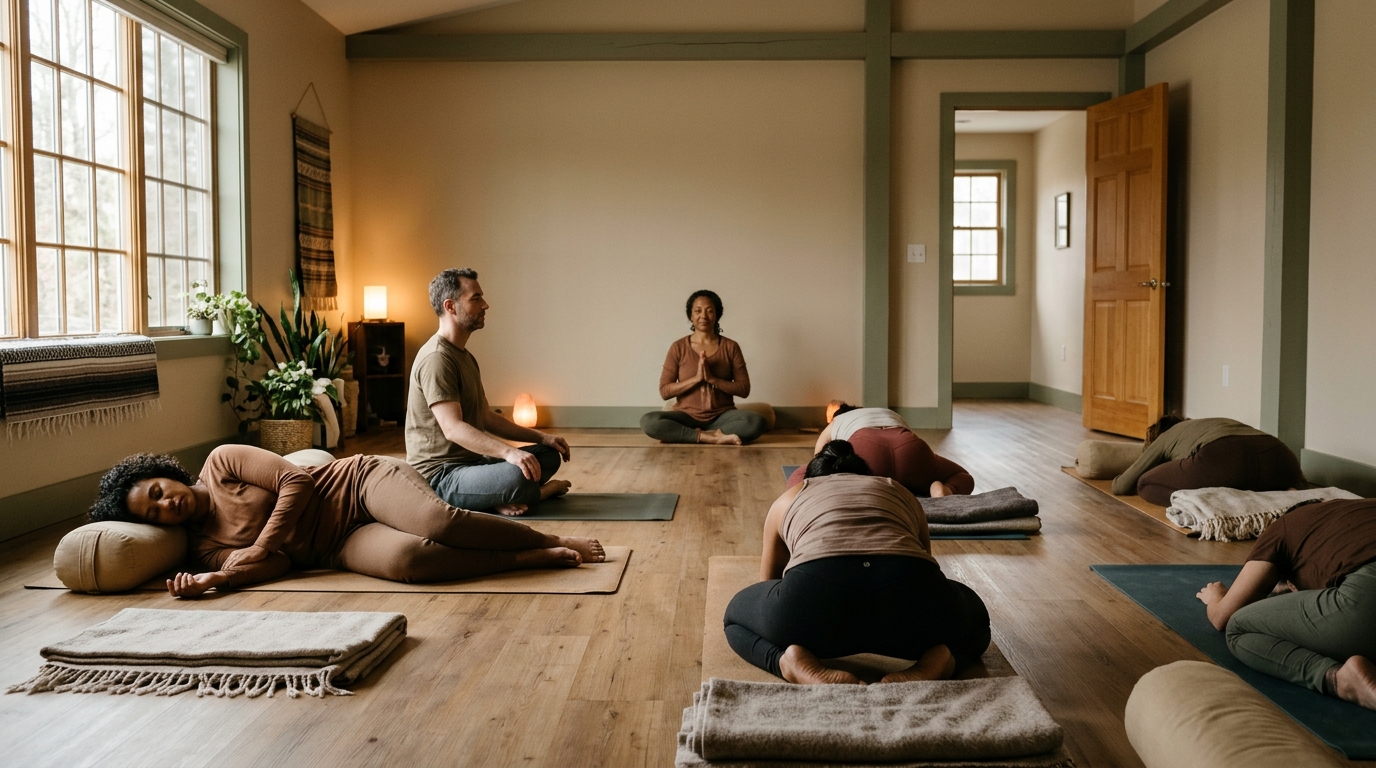
| Safety and predictability | Soft light, a clear layout without mirrors or closed circles, the teacher in a consistent spot, the class explained before it starts |
| Choice and agency | Invitational cues ("you might," "if it feels right for you") instead of commands; the student decides how, or whether, to move |
| No hands-on adjustments | No physical assists without explicit, prior consent |
| Interoception | Guided attention to internal sensation at a tolerable pace, without revisiting the trauma story |
The full definition, including where it differs from trauma-sensitive yoga and what the label is not, lives on its own page: what is trauma informed yoga.
Why it matters more inside a treatment center
A studio student chose to be there. A client in a residential program often didn't. Some are days into detox. Some are watching the door the entire first session.
That changes the stakes of every cue. "Close your eyes" in a studio is an instruction. In a room full of people whose nervous systems learned to stay on guard, it's a request to surrender the one defense they trust. "Push through" to a person in recovery can sound exactly like the voice they're trying to recover from.
The framework exists so that the practice doesn't accidentally recreate the conditions a client's body is bracing against. In a clinical setting, that's not a nice-to-have. It's the difference between a session that helps the clinical work and one that undoes an afternoon of it.
What actually changes in a room when the teacher is trauma-informed?
Four things, and a clinical director can watch for every one of them from the back of the room.
The opening. A trauma-informed teacher names what the session will include and says, out loud, that every shape is optional. Nothing that follows is a surprise.
The language. Invitation replaces instruction. The teacher offers; the client decides. Staying seated while the room moves is a valid answer to every cue, and nobody makes it wrong.
The touch. There isn't any, unless a client explicitly asks and agrees first. Hands never arrive from behind.
The response. When a client cries, freezes, or gets up to leave, the teacher doesn't spotlight them or try to fix it. They quietly check whether the person wants support, then give them the freedom and the dignity to have their own experience in its fullness, without making it wrong.
That last one is the skill no certificate can print, and it's what I watch for in every audition. The practice itself, including which poses help and which to avoid, is in yoga for trauma release.
What goes wrong when a teacher is not trauma-informed?
I can't give you a story from our network. I can tell you exactly what my vetting is built to keep out, because every item on this list is a failure mode a trauma-informed teacher is trained to avoid.
| Failure mode | What an untrained teacher does | What a trauma-informed teacher does instead |
|---|---|---|
| Unannounced touch | Presses a hand on a client's back from behind to deepen a fold | Never touches without asking first; never approaches from a blind spot |
| Command language | "Keep your eyes closed. Don't look around. Push through." | "You might let your eyes close, or soften your gaze." Every cue has an exit |
| Exposed room setup | Clients face away from the door; exposed pelvic shapes offered without options; teacher circles behind | Nobody has their back to the door; vulnerable shapes are optional and supported; teacher stays visible |
| Rushing a release | Tries to cheer up a crying client, or turns their tears into a lesson for the room | Quiet check-in, then space and dignity, no spotlight |
Each of those can send a client's nervous system straight back into hypervigilance, shutdown, or dissociation. None of them is dramatic, and all of them happen in ordinary studio classes every day. That's exactly why a studio teacher can't be dropped into a clinical room without the training.
What should a facility require of its yoga facilitators?
This is the standard every practitioner in our network meets. I'd suggest it as a floor for any program bringing trauma-informed yoga in-house.
Credentials. A 200-hour ERYT at minimum, with at least two years of related experience and trauma-informed training. The E matters: it means documented teaching hours, not a certificate alone. Some practitioners in our network carry considerably more than this.
Group size. Five to seven clients is ideal, and never more than ten, because a teacher can't hold space they can't see. In clinical settings enrollment sometimes decides the number for us, and we make suggestions to the administration when it does. That's when the teacher's capacity to hold a room matters most.
Staff buy-in. Noise and conversation from outside the session room can trigger a client right as they're starting to relax, and a counselor walking in mid-session to pull someone for an appointment can undo the work. So clinical staff need to know a session is running and what it needs from them, and clients should be told in advance if they'll be called out, or the appointment moved.
Two disqualifiers. Any dissociating substance around practice, and any hands-on contact without consent. Either one ends the conversation.
An audition. A certificate proves hours. Watching someone teach proves whether they can hold a room. What I'm looking for in that audition, in my own words, is the care they bring to their work and the desire to make a positive difference in the lives of others and their experience of suffering, which is often born from their own healing journey and personal work. What the certificate does and doesn't prove is in trauma informed yoga certification, what it proves.
If you're vetting individual teachers yourself, the buyer's checklist is in what trauma-informed really means for facilitators.
Is trauma-informed yoga evidence-based?
Partly, and it's worth being precise about which part.
The strongest evidence sits with the clinical, manualized version. Trauma Center Trauma-Sensitive Yoga (TCTSY) is a structured intervention whose facilitator certification runs 300 program hours, according to the TCTSY program, which describes it as a validated intervention for complex trauma and PTSD and cites a 2023 randomized trial comparing it with Cognitive Processing Therapy. Trauma-sensitive yoga has also been studied as a complementary treatment for PTSD, with the research summarized there reporting greater symptom reductions for women in a yoga group than for waitlist controls.
The broader studio framework rests on trauma-informed care principles and has a thinner research base, because it describes an approach rather than a protocol that can be tested the same way. Anyone who tells you trauma-informed yoga is a guaranteed cure for anything is selling something.
What I track in my own rooms is narrower: willingness to participate over weeks. The client who sat out the first session and folds forward in the third is the metric that tells me the nervous system has stopped expecting harm.
How does it fit alongside clinical treatment, and where is the scope line?
Trauma-informed yoga is a complement to clinical care, never a substitute for it. A trained teacher can hold a safe room, respond well when something surfaces, and help a client come back into their body. A teacher cannot treat PTSD, process trauma narratives, or diagnose, and the good ones say so.
In a well-run program the clinician leads and the practice supports. Regulated nervous systems do the clinical work; dysregulated ones leave. That's the practical case for the yoga room: not that it heals trauma, but that it gives the clinical team a client who can stay in the building and stay in the conversation.
Here's what that has looked like for one of the programs our network serves. Keefer W., Regional Director at Clear Behavioral Health, put it this way:
"Working with the Coliberation Wellness team has been an absolute pleasure. Their expertise in yoga, breathwork, Meditation and sound healing is evident, and their services have truly made a positive impact on our wellness initiatives across our mental health and dual diagnosis programs. Everything they offer feels thoughtful, personalized, and authentic."
The mechanism underneath all of it, why a settled nervous system can engage and a braced one can't, is the subject of our hub on nervous system regulation.
The rest of the cluster: the questions this hub hands off
Does yoga release trauma?
It can support release, but the pose isn't what does it. Release happens when the nervous system feels safe enough to stop bracing, which is why choice and pace matter more than hip openers. The full answer, including which poses help and which to avoid, is in yoga for trauma release.
How do I find a real class?
The label is unregulated, so the test is the first five minutes: how the teacher opens, how the room is set, how they cue, and whether props are offered before anyone asks. The field guide, with the questions to ask before booking, is in trauma informed yoga classes.
What certification do teachers need?
Programs run from 20-hour workshops to 300-hour clinical certifications, and the certificate proves hours rather than readiness for a clinical room. What each level covers, and what a treatment center still checks, is in trauma informed yoga certification.
How do I vet a facilitator for my program?
The buyer's checklist, written for clinical and program directors, is in what trauma-informed really means for facilitators.
The room is the product
If you run a program, the question isn't whether trauma-informed yoga works in the abstract. It's whether the person leading your Thursday session can hold a room where someone may dissociate, cry, or bolt, and do it without making anything worse.
That's a vetting problem before it's a yoga problem. Get the vetting right and you won't need a horror story to explain the trauma-informed part to your board. You'll have the opposite: a room clients start counting down to.
Picture your program six months from now. When a practitioner is out, a vetted substitute is a request away, and clinical staff know what the session needs from them. The client who spent the first week watching the door is in child's pose, eyes closed, and your counselors are getting a calmer version of that person an hour later. That's what trauma informed yoga looks like when the vetting is done properly.
Bringing trauma-informed yoga into your program
Coliberation Wellness is a curated referral network connecting treatment centers and behavioral health programs with vetted, insured, trauma-informed independent practitioners. We handle vetting, credential and insurance verification, matching, scheduling coordination, and one consolidated invoice, with substitute referrals at your request. Every practitioner we refer meets the standard on this page before they meet your clients.
How we match a specific practitioner to a specific room, after the vetting, is the part I'd rather walk you through than write down.
Talk to us about trauma-informed yoga for your program. No pitch, just an honest conversation about whether it fits.