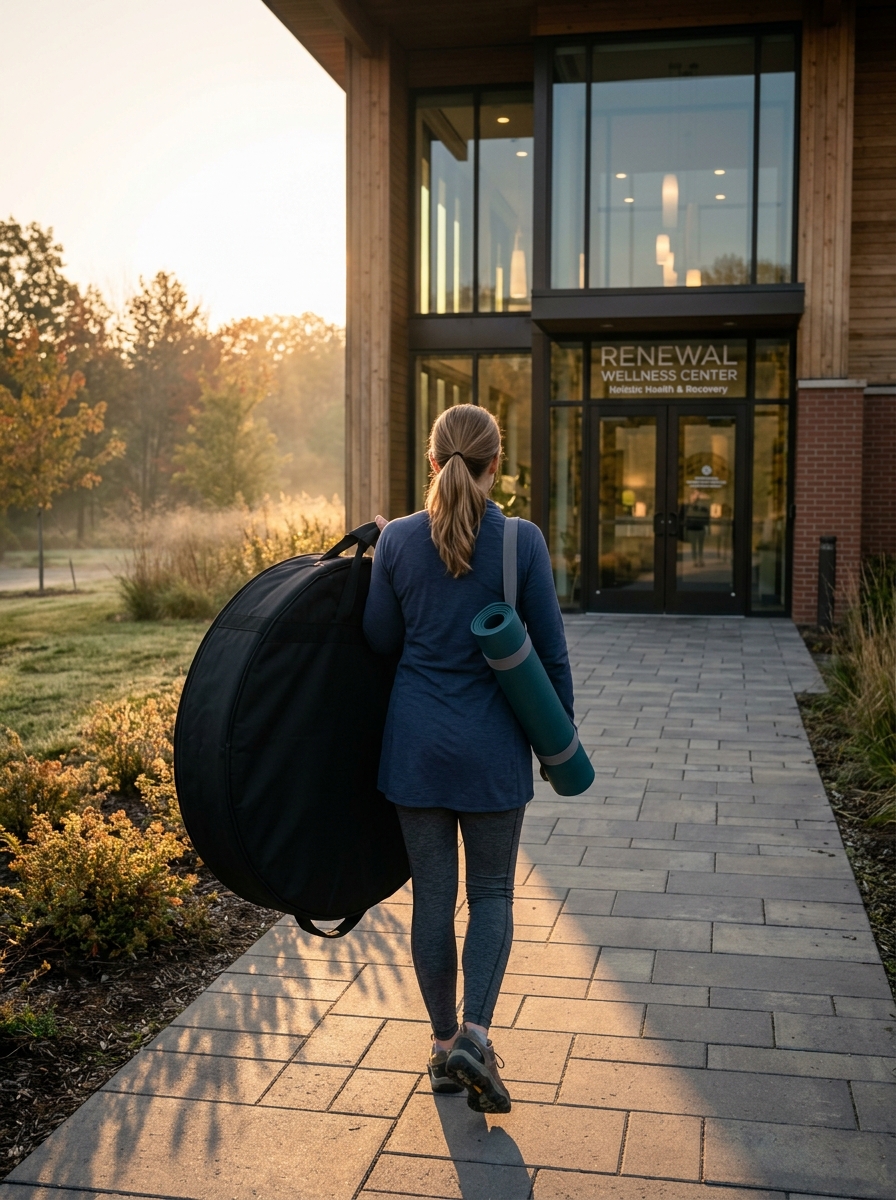
It's 9:40 on a Monday morning. A practitioner is carrying a gong through the side door of a treatment facility, past the intake office, toward a group room where ten clients are about to have their first experiential therapy session of the week.
By Saturday afternoon, that same scene will have repeated dozens of times across the locations my team serves: sound baths, yoga classes, breathwork, and mindfulness meditation, woven into treatment schedules from mid-morning through late afternoon, Monday through Saturday.
Most articles about experiential therapy in rehab describe modalities in the abstract. Almost nobody shows you the operating reality: who shows up where, what happens when a client refuses, what a practitioner's first day is actually like, and what changes in a group between week one and week four. That's what this post maps, from the experiential wellness side, the yoga, sound, breath, and meditation sessions certified practitioners deliver alongside the clinician-led experiential and talk therapy your program runs.
In rehab settings, experiential therapy and experiential wellness programming run as scheduled group sessions, typically two to four per week per program: sound healing and yoga most commonly, with breathwork and mindfulness meditation added as programs grow. The wellness sessions this post maps are delivered by certified practitioners, slot between clinical hours (mostly 10am to 4pm), and clients attend as part of the program rather than as an elective.
Here's the week, from the inside.
The shape of a real week
Across the multi-location client my team serves in Los Angeles and Orange County, the weekly rhythm looks like this.
Mondays run heavy: sound baths at several locations through the morning, yoga at midday, more sound sessions into the afternoon. Midweek stacks the most volume, with sound healing, breathwork, and mindfulness meditation layered across sites from 10am to around 2:30pm. Fridays bring yoga and sound in roughly equal measure. Saturdays close the week with a pair of afternoon sound sessions.
A few patterns inside that rhythm are worth an operator's attention.
Sound healing dominates the calendar, roughly double any other modality. That's demand talking: it's the session clients accept fastest and facilities expand first, for reasons I laid out in what the best experiential therapy programs get right.
Practitioners cover multiple sites. A single facilitator might play a morning sound bath in the South Bay and an afternoon session in Pasadena. That routing is invisible to the facility, and it should be; scheduling is the provider's problem, not the clinical team's.
And the whole calendar sits inside treatment hours. Sessions don't compete with clinical programming; they're placed between it, which is exactly where the regulation mechanism does its best work: a client who settles at 10am does deeper clinical work at 1pm.
What a practitioner's first day is really like
Here's what surprises new facilitators most, and it tells you something about the setting your clients live in.
They expect a yoga studio: contained, quiet, propped, sacred. What they find is a treatment facility making the best use of the space it has.
Sometimes the session room doubles as a group room. Sometimes there's no door and a curtain gets hung. The props may be a stack of donated blankets.
Good practitioners adapt, and great ones treat the adaptation as part of the work. But the gap between studio expectations and clinical reality is why I audition for command and flexibility, not just technique. A practitioner who needs perfect conditions to deliver a session has no business in this field.
For facilities, the flip side of that tolerance is a request: every improvement toward containment, a real door, protected time, actual props, pays back directly in outcomes. Adaptability is not an excuse to skip the room checklist.
Same modality, different room: levels of care
The biggest practical split my facilitators navigate isn't between modalities. It's between populations.
In addiction recovery and detox settings, the work carries 12-step considerations. Clients are managing cravings, sometimes raw from withdrawal, repatterning their entire lives around becoming clean. Reflections after sessions lean toward the transition into the sober self: what to grow, what to release.
In mental and behavioral health settings, the room holds anxiety, depression, professional overwhelm, identity crises, personality disorders, suicidality. The same gong plays, but the framing, the pacing, and the reflection topics shift to meet what's actually present.
Dual diagnosis programs blend both, though facilities often keep the two paradigms operationally separate. A practitioner who can name how their session changes across these rooms has worked in them. One who can't is guessing.
Inside one session: the 60-minute arc
To make the calendar concrete, here's how a typical sound session actually runs inside a treatment program's experiential therapy and wellness block. Every practitioner has their own instrument kit and order; this is the arc I built mine around, and it holds up in clinical rooms.
The first seven to ten minutes are guided settling. Clients sit or lie down; the facilitator walks them through shaking out limbs, softening the jaw and tongue, letting exhales fall out of the mouth. This is also where the mystery gets dispelled: naming the instruments coming, previewing the experiences that might arise, and giving one crucial instruction. If restlessness or agitation surfaces, that's stored tension lifting; breathe through it and let it pass.
Then the instruments, in a deliberate order. The gong first, because it's the most grounding and reassuring voice in the room. An ocean drum next, wave sounds that are cleansing and occasionally, intentionally, a little confronting. The quartz crystal bowls last and longest, about twenty minutes of circular tones that quiet thinking itself.
The return takes three to five minutes: fingers and toes, knees to chest, a slow roll to one side, rising to seated. Then the part operators underestimate: reflection.
The facilitator opens the floor. In recovery rooms the prompt leans toward the transition into sobriety. In behavioral health rooms it's the shift between the state clients walked in with and the one they're sitting in now.
When a group is shy, a seeded question works: name one of the biggest blessings in your life, or a time a failure turned into a success. The point is normalizing self-reflection out loud, in front of others, which is precisely the muscle clinical group work depends on.
One honest note from the trenches: the biggest disruption in a clinical sound session isn't resistance. It's snoring. A client who drops into deep sleep is getting exactly what their nervous system ordered, and the facilitator's job becomes protecting everyone else's experience around it. Small problem, real problem, and the kind of thing you only learn by running these rooms weekly.
What clients take out of the room
The session ends; the tools don't. Facilitators seed take-home practices constantly, and the simplest one travels best: ten deep breaths before acting on a craving or a hard moment.
It works because of a principle my whole approach rests on: regulate first, resolve second. A decision made by a settled nervous system is a different decision. Clients who learn that in a Tuesday sound bath start applying it in Friday's family visit, and counselors tell me they can hear the difference in how clients narrate their week.
When a client refuses
It happens constantly, and any provider who claims otherwise is selling you something.
In participatory modalities, yoga and breathwork especially, clients text, drift, or flatly decline. Some are in the facility by court direction or family enrollment rather than choice, and their willingness reflects that. Refusal in these rooms is rarely about the practice; it's fear wearing a bored face.
The operating agreement that works: facilities treat sessions as part of treatment, not an elective, with exceptions for injury. Facilitators hold the room but never discipline; their move is to keep the invitation open, and when someone actively disrupts, to ask them to get with the program or step out with dignity intact.
What I tell my practitioners: expect the resistance, never take it personally, and watch what happens to the resisters by week four. They're often the ones who end up sharing most.
There's a version of refusal that isn't defiance at all, and it deserves its own mention: the client who participates but stays armored. Eyes open through the whole sound bath. Positioned near the door, checking the room every few minutes.
That's a nervous system doing its job, scanning for threat. The correct response is patience, not pressure, and a facilitator trained for these rooms knows the difference on sight.
Give that client three weeks of the same session, in the same room, at the same time, delivered by the same calm voice. Predictability is what convinces a hypervigilant system to stand down, and no amount of coaxing substitutes for it. The armored ones don't announce their shift; one week they simply close their eyes, and everyone holding the room knows what it took.
Week one to week four: the arc I watch
Consistent sessions produce a recognizable progression, and it's quieter than most directors expect.
Week one is guarded. Bodies stay tense, eyes stay open, participation is compliance. For clients carrying trauma, that's not failure; dissociation from the body is the baseline this work exists to address.
By week two or three, sleep reports improve and the restlessness of early sessions softens. Clients begin arriving on time. The first unprompted shares happen after sessions, and sharing is my leading indicator that the work is landing.
By week four, there's a visible sense of calm, grounded embodiment. Clients who lived in survival mode reclaim somatic presence: they inhabit their bodies instead of monitoring them. Curiosity, vulnerability, hope, and self-acceptance show up in group. Counselors notice clients bringing session experiences into clinical work, giving therapy new material to hold.
None of this replaces the clinical arc. It runs underneath it, and it's why programs with consistent experiential therapy report the compatibility they do: the sessions regulate what the therapy then resolves.
What the clinical teams feed back
The reports that reach me from counselors and directors are consistent enough to summarize as a pattern.
Client satisfaction runs higher than expected. The experiential sessions and clinical work turn out to be natural allies rather than calendar rivals. And the professionalism of the practitioners keeps surprising teams who quietly expected hobbyists, a misconception I've written about in the best programs post.
The other thing they notice is what doesn't happen: programming doesn't go dark. When a facilitator is sick or traveling, a substitute with the same modality and the same trauma-informed training steps in. I keep a dedicated sub bench for exactly this, because a client routine that collapses every time one person catches the flu isn't infrastructure, it's a liability wearing a schedule.
From signed agreement to first session
Facilities always ask how long it takes to stand a calendar like this up. The sequence is shorter than most expect, and knowing it lets you plan a launch date honestly.
It starts with your programming call: how many experiential therapy sessions per week, which modalities, which days and times. Most programs open with yoga and sound healing and expand from there.
Staffing comes next. For my team that means assigning practitioners from the existing bench or recruiting in your region against a values-first hiring protocol, then a contractor agreement, then certifications and paperwork collected before your organization ever meets a name.
The final leg belongs to your HR process: compliance paperwork, a health check, a TB test. Once those clear, the practitioner is on your calendar, and the week starts taking the shape this post has been mapping.
The practical takeaway for planning: the slow variable isn't the provider, it's your own onboarding pipeline. Facilities that pre-clear the HR steps launch experiential therapy programming weeks faster than facilities that discover them one at a time.
Running the week without owning the chaos
Everything above happens without the facility managing any of it: no recruiting, no vetting, no scheduling across sites, no scrambling when someone's out. That's the design.
If your program is considering experiential therapy in rehab settings, walk your building this week with two questions. Where would sessions actually happen, and who on your team would own the calendar if the answer is "nobody"? The first question costs a room. The second is the reason providers like mine exist.
The week is the product
Anyone can deliver one good session. What changes outcomes is the boring miracle of the same sessions happening on the same days for months, across every location, regardless of who's sick or traveling.
Picture your intake conversation a quarter from now: a prospective family asks what makes your program different, and part of your answer is a weekly experiential calendar that has not missed a session since it started.
The team behind a week like that
Coliberation Wellness runs these calendars as a managed service: certified, trauma-informed, insured practitioners across yoga, sound healing, breathwork, and mindfulness meditation, delivered in person across multiple locations, with vetting done before your HR process starts and substitutes guaranteed.
How that guarantee actually works, and the one question I ask about every room before scheduling a single session, is inside the operator's guide to experiential therapy for treatment centers.
If your week needs this shape, tell me about your program. I read every message.
Warmly,
Kara