Most corporate wellness events are forgotten by Friday. The smoothie cart, the chair-massage line, the lunch-and-learn nobody remembers. People show up for the free thing, then go back to their inbox exactly as depleted as before.
It doesn't have to be that way. The right session can genuinely reset a room, and people talk about it for weeks.
The difference isn't budget. It's whether the event does something to the body and whether it's run by someone who knows how to hold a group. I've run these for physician gatherings and stressed teams, and the ones that land follow a pattern.
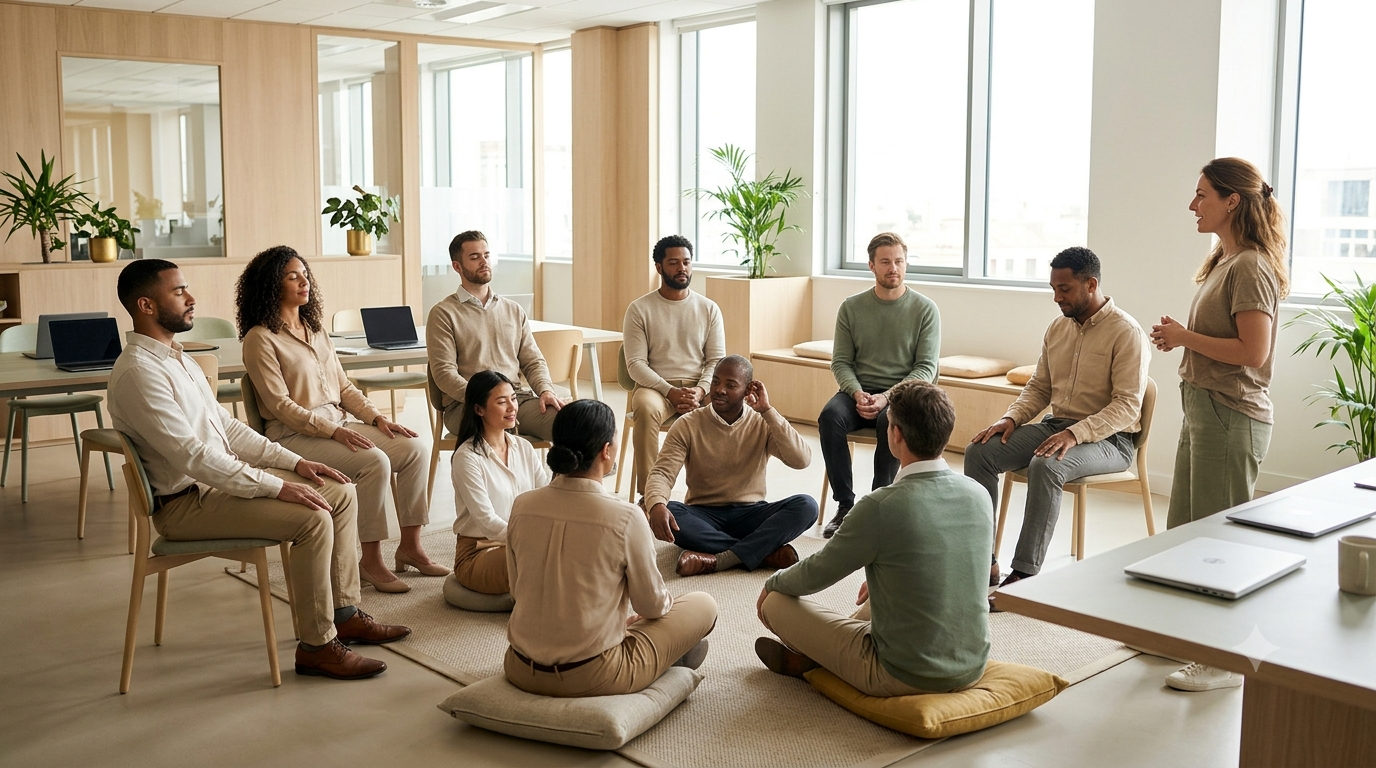
Corporate wellness events that land are experiential, not passive: a guided sound bath, breathwork, or yoga session that shifts people's physical state in real time. What separates a memorable event from a forgotten perk is a trained facilitator, a modality matched to the group, leadership in the room, and enough containment that people can actually let go. The activity matters less than whether it moves the nervous system.
Here's what that looks like in practice.
Why most corporate wellness events don't land
Start with the honest failure mode. A lot of corporate wellness events are designed to be seen, not felt. They photograph well and change nothing, because they never touch the thing that's actually worn down: the nervous system.
A team running on stress doesn't need a novelty. It needs a real break that its body registers. Passive perks, a snack, a giveaway, a talk, don't do that. Programs and experiences that require genuine engagement and guided practice are what drive an actual shift, and passive ones get forgotten.
There's also a trust problem. When wellness events feel like a box being checked, people get cynical, and cynicism kills attendance at the next one. The event has to be real enough that people leave different than they arrived.
What makes a corporate wellness event actually land
Four things, in order of importance.
A trained, insured facilitator
This is the whole game. A skilled facilitator reads the room, sets the tone, and adapts on the fly, which is what makes a session feel safe enough to let go into. Credentialing also matters for safety: a mixed group may include people carrying real stress or trauma, and an intense practice run by someone untrained can do harm. For corporate wellness events, the facilitator is the product.
A modality matched to the group
An exhausted care team, a sales floor after a launch, and a leadership offsite each need something different.
Sound and guided meditation suit a depleted group that just needs to stop. Breathwork suits a team that needs to discharge tension and refocus. Movement suits a group that's been sitting for days. Matching the practice to the room is the difference between a hit and a polite miss.
Leadership in the room
When leaders join the session instead of hovering at the back on their phones, the whole meaning changes. It signals that recovery is allowed and valued, and participation rises accordingly. When leadership opts out, everyone else reads that as permission to opt out too.
Enough containment to let go
People can't drop into a reset in a chaotic space with the door open and laptops pinging. The room, the timing, and a little protection from interruptions all matter. Great facilitators adapt to imperfect spaces, but the more containment you can offer, the deeper the session goes.
The corporate wellness events that work best
Here are the formats my team runs most often for companies, and when each fits.
A sound bath is the most accessible corporate wellness event there is. People lie down, the facilitator plays crystal bowls and a gong, and a whole room drops into rest in forty minutes. It asks nothing of the body, so participation is high and skeptics come around fast. It's the easiest first event to say yes to.
A guided breathwork session gives a team a fast, physical reset. Slow, guided breathing measurably lowers stress and improves resilience (Fincham et al., Scientific Reports, 2023), and it's a strong choice before a demanding stretch or after an intense one. Guided is the operative word; a trained facilitator keeps it safe.
A yoga or gentle movement session suits teams that have been sitting and grinding. Chair-based options let people join in work clothes with no gym required, which keeps it inclusive.
A combined experience works well for bigger moments: breath to arrive, movement to loosen, sound to close. This is the format we've used for larger professional gatherings, including physician events, where you want to move a big group from wired to settled in one arc.
Where corporate wellness events fit in a bigger plan
One event is a taste. The real value shows up when a great event becomes a standing rhythm.
The strongest use of corporate wellness events is twofold. Use marquee events for the moments that matter, year-end crunch, a reorg week, an offsite, when a team most needs to exhale together. Then convert the ones that clearly land into a recurring session, because consistency is what turns a nice memory into a real change in how people function.
If you're thinking about the standing version, the guide to corporate wellness programs employees actually use lays out how to build it, and the piece on employee wellness program ideas covers which formats fill a room week to week. If leadership wants the business case first, whether corporate wellness programs work has the honest ROI answer.
How to plan one that doesn't flop
A short checklist that prevents most flops.
Pick the modality for the group you actually have, not the one that sounds impressive. Protect the time and the space so people can drop in.
Get at least one visible leader to attend and to say why.
Use a real, insured facilitator rather than a well-meaning volunteer. And decide in advance what a good outcome looks like, whether that's attendance, the energy in the room afterward, or the number of people who ask when the next one is.
For multi-site or hybrid companies, plan for coverage. An event that only happens where the facilitator happens to be, or that gets canceled when one person is sick, teaches people not to rely on it. A managed team that guarantees a qualified substitute is what keeps the experience consistent across locations.
How to plan a corporate wellness event, step by step
Planning one of these well isn't complicated, but a few decisions make or break it. Here's the sequence I walk clients through.
Start with the moment, not the modality. Ask what this event is for. A reset before year-end crunch, a thank-you after a brutal quarter, a reconnect for a distributed team, a calming close to an offsite. The purpose tells you the modality, not the other way around.
Read the group honestly. How depleted are they? How comfortable with wellness? A skeptical, never-done-this crowd wants sound or gentle breath, nothing that asks them to perform. A group that already practices can handle more. Corporate wellness events flop when the modality outruns the room's comfort.
Lock the logistics early. Pick a time people can actually protect, ideally not jammed against a deadline. Choose a space that can be made quiet and dim enough to drop into. Confirm how many people, so the facilitator can plan the instruments and the arc. For a virtual event, test the audio, because sound and voice guidance live or die on it.
Brief your leaders. Ask at least one visible leader to attend and, ideally, to open the session with a sentence about why it matters. Their presence does more for turnout and impact than any amount of promotion.
Set the success measure before the event. Decide what a win looks like, attendance, the energy in the room afterward, or how many people ask when the next one is, so you can tell whether to repeat it.
Plan for coverage. If it's part of a series or spans multiple sites, make sure a qualified substitute can step in when a facilitator is out. Corporate wellness events lose all their momentum when they cancel unpredictably.
Do those six things and the event itself becomes the easy part.
Turning one event into momentum
A single event is a spark. The teams that get real value treat a great corporate wellness event as the start of something, not a one-off.
The move is simple. After an event that clearly lands, ask the room if they'd want it regularly, and watch the faces, not just the hands. If the energy is there, convert it into a standing session at a fixed time. The recurring version is where the compounding happens, because a nervous system changes through repetition, not through a single good afternoon.
Events and standing programs aren't competitors. Events are the on-ramp that proves the value and gets leadership bought in. The standing session is what turns that proof into a durable change in how the team functions.
What a good one feels like
You can feel a corporate wellness event land. The room that walked in wired and distracted walks out loose and quiet. People linger instead of bolting for their laptops. Someone who rolled their eyes at "another wellness thing" catches you afterward to say that was actually really good.
Over time, if you convert the winners into a rhythm, the effect compounds. Attendance climbs, people start protecting the session on their own calendars, and managers tell you the team feels steadier in the weeks around it. That's the return you can't get from a smoothie cart.
A note on budget and value
The instinct is to judge an event by its price tag. The better lens is value per person who actually felt something.
A cheap event nobody remembers is expensive, because you spent real money and moved nothing. A well-run session that resets a room and gets people talking for a week is a bargain by comparison, even at a higher line-item cost. Judge by impact, not by invoice.
The same logic applies to frequency. One memorable event a quarter, converted into a standing session for the teams that loved it, tends to deliver more than a scattered calendar of one-offs that never build on each other. Spend where the effect compounds.
And factor in reliability. An event that gets canceled at the last minute because a single facilitator fell through costs you more than the fee, it costs the trust you were trying to build. Paying for coverage, so a qualified substitute can always step in, protects the value you're paying for in the first place.
None of this means spend more. It means spend where people feel it, and stop spending where they don't.
Where to start
A corporate wellness event only earns its budget if people feel it. Choose an experiential session, match it to the team you actually have, put a trained facilitator in front of it, get a leader in the room, and protect enough space for people to let go. Then take whatever clearly lands and turn it into a rhythm.
Pick one moment on your calendar that your team could use a reset for, and build the event around that. The best first event is usually tied to a real pressure point, the week before a launch, the day after a hard quarter closes, the afternoon of an offsite. Attach the reset to a moment people already feel, and attendance takes care of itself.
How Coliberation runs corporate wellness events that land
If you want an event people actually feel, this is what my team does. Coliberation brings certified, trauma-informed facilitators to companies for on-site and live-virtual sessions across sound, breathwork, movement, and meditation, for one-off events and standing programs alike.
Here's the mechanism. You get a managed team, so a facilitator being out never cancels your event; a trained substitute in the same modality steps in. You get one point of contact and one invoice across every event and location.
Every facilitator is trauma-informed, certified, and insured, so the room is safe and the risk stays off your plate. And each event is matched to your group, because different rooms need different practices. There's one more piece to how we hold quality across a roster, and it's the first thing I'll walk you through on a call.
We've delivered this kind of work for groups like Kaiser Permanente, including an event for more than 150 physicians. Picture your next big moment closing with a room that actually exhaled together.
See our In-Person programs or book a discovery call and tell me about the event you have in mind. If we're a fit, I'll help you design corporate wellness events your people actually feel. If we're not, I'll tell you that too.
Warmly,
Kara