Most employee wellness ideas look great in the planning doc and empty out in real life. You send the calendar invite, block the room, order the mats, and eleven people show up out of two hundred. Then the idea gets quietly shelved and labeled "our people just aren't into wellness."
They are. They're just not into what got offered, or how it got offered. After years of running these sessions inside companies and treatment programs, I can tell you the difference between an idea that fills a room and one that doesn't has almost nothing to do with the activity and everything to do with whether it's real, in-person, and reliable.
The employee wellness ideas people actually show up for share three traits: they're experiential (something you do with your body, not another screen), they're facilitated live by a real person, and they run on a consistent schedule. On-site sound baths, guided breathwork, chair yoga, and led meditation outperform apps and one-off wellness days because people feel the result immediately and come back for it.
Let me give you the menu, then how to choose.
What makes an employee wellness idea actually land
Before the list, the test. A good idea passes three filters, and most failed programs flunk at least one.
First, is it experiential? Programs that ask people to engage, move, and practice drive real change, while passive perks get ignored. An app is one more task on the same device that's draining them. A live session in a room is a genuine break.
Second, is it facilitated? A person at the front who can read the room and adjust is what makes a session safe and worth attending. A pre-recorded video can't do that, and people can tell.
Third, is it consistent? A one-time wellness fair is a nice gesture that changes nothing. The same session, same time, every week is what builds a habit and lets a nervous system trust the reset.
If an employee wellness idea passes all three, it has a real shot. If it fails one, no amount of promotion saves it.
On-site employee wellness ideas that fill the room
Here are the experiences my team runs most, and why each earns attendance.
Sound baths
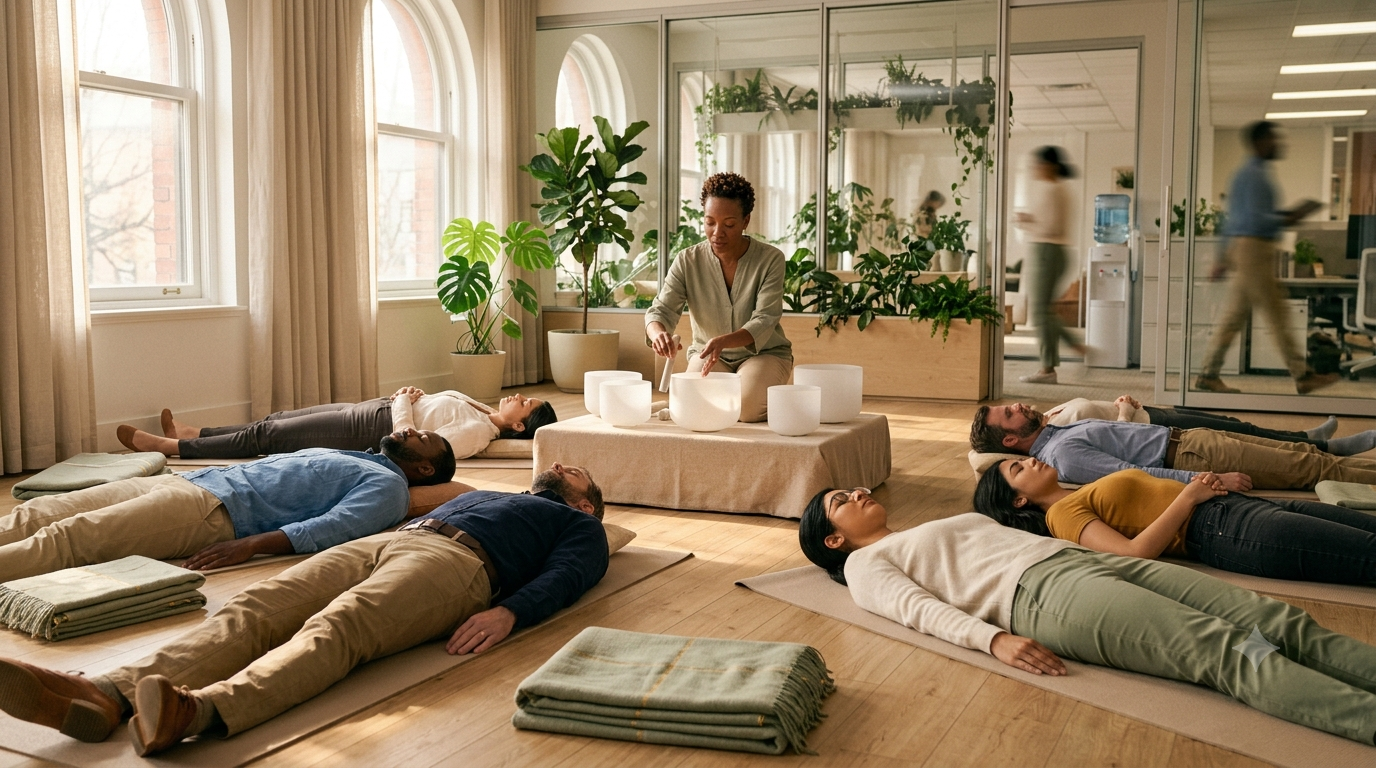
A sound bath is the easiest first yes in corporate wellness. People lie down, the facilitator plays crystal bowls and a gong, and forty minutes later a whole room is visibly calmer. It asks nothing of the body, so nobody worries about being flexible or fit, and the effect is immediate enough that first-timers come back. For a stressed team, this is the single highest-attendance session we offer.
Guided breathwork resets
A short, guided breathwork session before a hard week or after a launch gives people a fast, physical way to down-regulate. Slow, guided breathing measurably lowers stress and improves resilience (Fincham et al., Scientific Reports, 2023). The key word is guided. A trained facilitator keeps the practice gentle and safe, which matters because intense, unguided breathwork can rattle someone who's already fragile.
Chair yoga and gentle movement
Not everyone will roll out a mat, and that's fine. Chair-based yoga and gentle movement let people participate in work clothes, at their desk area or in a conference room, with no gym and no changing. It's the most inclusive movement option and a strong pick for teams that swear they "don't do yoga."
Led meditation and mindfulness
A live, guided meditation is different from telling people to open an app. Someone holds the space, sets the tone, and gives the group permission to actually stop. Ten to twenty minutes, midday, is enough to reset attention for the afternoon.
Midday wellness breaks built into the workday
The highest-leverage employee wellness idea isn't an event at all. It's protecting a real break and putting something restorative in it. A recurring fifteen-minute reset between the two hardest meeting blocks does more than a quarterly wellness day, because it meets people exactly when they need it.
Seasonal and milestone experiences
Save the bigger moments for when they count. A sound and breath session before year-end crunch, a restorative offsite after a brutal quarter, or a reset the week of a reorg lands harder than a random Tuesday. These are also the sessions leadership is most willing to join, which matters more than you'd think.
Which employee wellness idea to start with
Don't launch the menu. Launch one thing well.
Pick the modality that fits your culture and asks the least of people up front. For most teams that's a sound bath or a led meditation, because neither requires movement, changing, or any prior experience. Put it in one fixed weekly slot. Get one visible leader to attend and say out loud why they're there.
Then hold that slot long enough for it to become part of people's week. The instinct to add variety early is exactly what kills these programs. One reliable session that people build their Thursday around beats five sporadic ones they've learned not to count on.
How to run it so it doesn't fizzle in month two
A few operational details separate the programs that last from the ones that don't.
Protect the time. If wellness competes with "real work" every week, work wins and attendance craters. Leadership has to signal that stepping away for the session is allowed, ideally by doing it.
Use a real facilitator, not a volunteer with a playlist. Someone trained and insured, who can adapt to the room and hold it safely, is what makes people feel taken care of rather than managed.
Make it easy to attend. Same time, same place, on the shared calendar, no sign-up friction. Every extra step between an employee and the session is a reason to skip it.
For remote and hybrid teams, run a live-virtual version. A shared breathwork or meditation block over video gives distributed people a real pause and a moment of being in something together, which is the thing hybrid work strips away.
How to know it's working
Watch attendance and, more importantly, voluntary return. When the same faces come back and start asking when the next one is, the idea has landed. That's the signal you can't buy with a raffle.
Ask managers a simple question each month: does the team seem more settled after sessions? Their read is real data. Pair it with whatever engagement numbers you already track.
And if turnout is under 30%, treat that as feedback about the offering, not proof your people don't care. Usually it's the schedule, the awareness, or a lack of leadership buy-in, all fixable.
For the fuller picture on why programs stall and what moves the needle, see the guide to corporate wellness programs employees actually use. If burnout is the specific problem you're solving, the piece on how to reduce employee burnout goes deeper on the mechanism.
Matching the employee wellness idea to the team
The same session lands differently depending on who's in the room. Matching the idea to the actual team is one of the biggest levers on turnout, and it's usually overlooked.
For a depleted care team, a nursing floor, a support org, a clinical group, choose something that asks nothing and simply lets them stop. Sound baths and guided meditation are ideal, because these are people who give all day and rarely receive. The invitation is rest, not effort.
For a high-intensity sales or trading floor, breathwork tends to win. These teams carry a lot of activation and respond to a practice that lets them discharge it and refocus, especially before or after a big push. A calm meditation can feel too slow for a room that's still buzzing.
For engineers and knowledge workers who've been sitting and staring for days, gentle movement and chair yoga do the most good. Their stress is as physical as it is mental, hips, necks, shoulders, and a body-based reset gives them something the screen can't.
For a mixed or all-hands group, sound is the safest bet. It requires nothing, suits every fitness level, and moves a large, varied room in one arc. That's why so many employee wellness programs open with it.
Reading the room like this is exactly what a trained facilitator does in real time, and it's a big part of why credentialed delivery beats a generic template.
What to do when turnout is still low
Sometimes you do everything right and turnout still lags at first. Don't panic, and don't scrap it. Diagnose.
Check the timing. A slot that collides with a standing team meeting or the daily crunch will always lose. Midday, mid-week often works best.
Check the awareness. People forget; a simple day-of reminder and a manager mention move numbers more than you'd expect.
Check the safety. If people worry that stepping away looks like slacking, they won't come, no matter how good the session is. That's a leadership signal to fix, not an employee failing. And check the fit against the section above; the wrong modality for the room reads as "not for me."
Most low turnout is one of these four, and all four are fixable. An employee wellness idea rarely fails because people don't want to feel better. It fails on a detail of design, which means you can usually turn it around without changing the activity at all.
Mistakes that quietly sink good ideas
The common ones are avoidable. Launching six things at once and sustaining none. Choosing an intense modality for a fragile team and scaring people off.
Relying on apps and calling it a program. Letting leadership opt out while expecting everyone else to opt in. And treating wellness as an extra that vanishes the second the quarter gets busy, which teaches people it was never real.
Every one of those is a design choice, which means every one is fixable.
The one number worth watching
If you track a single thing, track voluntary return: the share of people who came once and chose to come back. It's a better signal than headcount at launch, because the first session always draws curiosity. The second, third, and fourth tell you whether the experience actually delivered.
When voluntary return is high, you've found something worth scaling. When it drops off after week one, the session looked good on paper but didn't land in the body, and that's your cue to adjust the modality, the timing, or the facilitator, not to add three more ideas on top.
This is also the number to bring to leadership. "Forty people came and thirty-two keep coming back on their own" is a far more convincing story than a one-time attendance spike, and it's the kind of evidence that gets a program funded for another quarter.
Most companies never measure this, which is exactly why so many can't tell whether their wellness spend does anything. Pick the metric that reflects real demand, and let it guide what you keep and what you cut.
Where to start
The reason employee wellness ideas fail is rarely the idea. It's that the offering was passive, sporadic, or unsupported. Flip those three and turnout follows. Pick one live, facilitated, consistent session, protect the time, get a leader in the room, and let people feel the result before you scale.
Choose the one thing your team is most likely to say yes to this month. Run it every week. Watch who comes back.
How Coliberation runs employee wellness that people attend
If you want that first reliable session without assembling a wellness function yourself, this is what my team does. Coliberation places certified, trauma-informed facilitators into companies for on-site and live-virtual sessions across sound, breathwork, movement, and meditation.
Here's the mechanism. You get a managed team, so one facilitator being out never cancels the session; a trained substitute in the same modality steps in. You get one point of contact and one invoice across every session and location.
Every facilitator is trauma-informed, certified, and insured, so the room is safe. And each session is matched to your people, because a care team and a sales floor need different things. There's one more piece to how we keep quality consistent across a roster, and it's the first thing I'll show you on a call.
We've delivered this kind of work for groups like Kaiser Permanente, including an event for more than 150 physicians. Picture a standing session your people build into their week, and managers telling you the team feels steadier.
See our In-Person programs or book a discovery call and tell me about your team and which employee wellness ideas you've already tried. If we're a fit, I'll help you pick the first session people will actually show up for. If we're not, I'll tell you that too.
Warmly,
Kara