Somatic exercises are the ones you do with your body rather than your thoughts, and for nervous system regulation they're often the fastest way in. When your mind is racing, trying to think your way calm rarely works. Giving your body a simple physical thing to do does.
I use these somatic exercises constantly in sessions, with clients in treatment who can't yet find words and with executives who live entirely in their heads. They're small, they're undramatic, and they work because they speak to the nervous system in its own language. Here are the ones worth learning first.
Somatic exercises for nervous system regulation are simple body-based practices that shift you out of the stress state and into recovery: the voo sound, audible sighing, gentle shaking, a self-hold, grounding through the feet, and slow movement. Each sends a physical safety signal to the nervous system, largely through the breath and the vagus nerve. They take one to three minutes, need no equipment, and work best practiced consistently rather than only in a crisis.
Let me walk you through each one and how to do it.
What "somatic" actually means
Before the exercises, a quick definition, because the word gets thrown around a lot. Somatic simply means "of the body." Somatic exercises are practices that work bottom-up, starting with physical sensation and movement to change your internal state, rather than top-down through thoughts and talk.
That direction is the whole point. When a nervous system is genuinely activated, the racing mind is downstream of the body's state, so reaching the body directly is often faster than reasoning with the mind. These somatic exercises are levers on the physical controls, the breath, the voice, the muscles, that your nervous system is actually built to respond to.
They also share a principle worth holding onto: we hold our issues in our tissues. Stress gets stored physically, and body-based practices give it a route out that talking alone can't reach.
The voo sound
This is my favorite place to start, because it pairs a long exhale with vibration, and it works on almost everyone.
Sit comfortably, take a slow breath in through the nose, and on the exhale make a low, sustained "voo" sound, like a foghorn, letting it vibrate in your chest and belly until the breath runs out. Pause, breathe in naturally, and repeat three or four times.
The voo comes from Somatic Experiencing, Peter Levine's body-based trauma work, and it does two regulating things at once. The long, voiced exhale presses the parasympathetic brake, and the vibration adds a physical cue of safety through the body. Of all the somatic exercises here, this is the one I'd have you try first, especially if you tend to live in your head.
Audible sighing
Even simpler than the voo, and something your body already knows how to do. A sigh is a built-in reset, and you can do it on purpose.
Breathe in through the nose, then let the air out through the mouth with an audible, unforced sigh, shoulders dropping as you exhale. Do it two or three times in a row. That's it.
The extended, voiced out-breath is again the active ingredient: it lengthens the exhale and signals the nervous system to settle. This is the most discreet of these somatic exercises, quiet enough to do at your desk or before a hard conversation without anyone noticing, which makes it one of the most useful for everyday life.
Gentle shaking
When you feel wired, frozen, or full of restless energy, shaking gives that activation somewhere to go. Animals do it instinctively after a threat passes, and your body knows how too.
Stand up, soften your knees, and let your hands and arms shake loosely, then let it spread to your legs and the rest of your body. Keep it easy, not forced, for about thirty seconds to a minute, then stop and stand still, and notice the settling that follows.
Shaking discharges stored tension physically, which is why it can relieve the wired-but-stuck feeling that breathing alone sometimes can't touch. Among these somatic exercises, it's the best one for moving from frozen or agitated into something workable, a good first step before quieter practices.
The self-hold
This one calms through gentle pressure and the felt sense of containment, and it's especially good when you feel scattered or shaky.
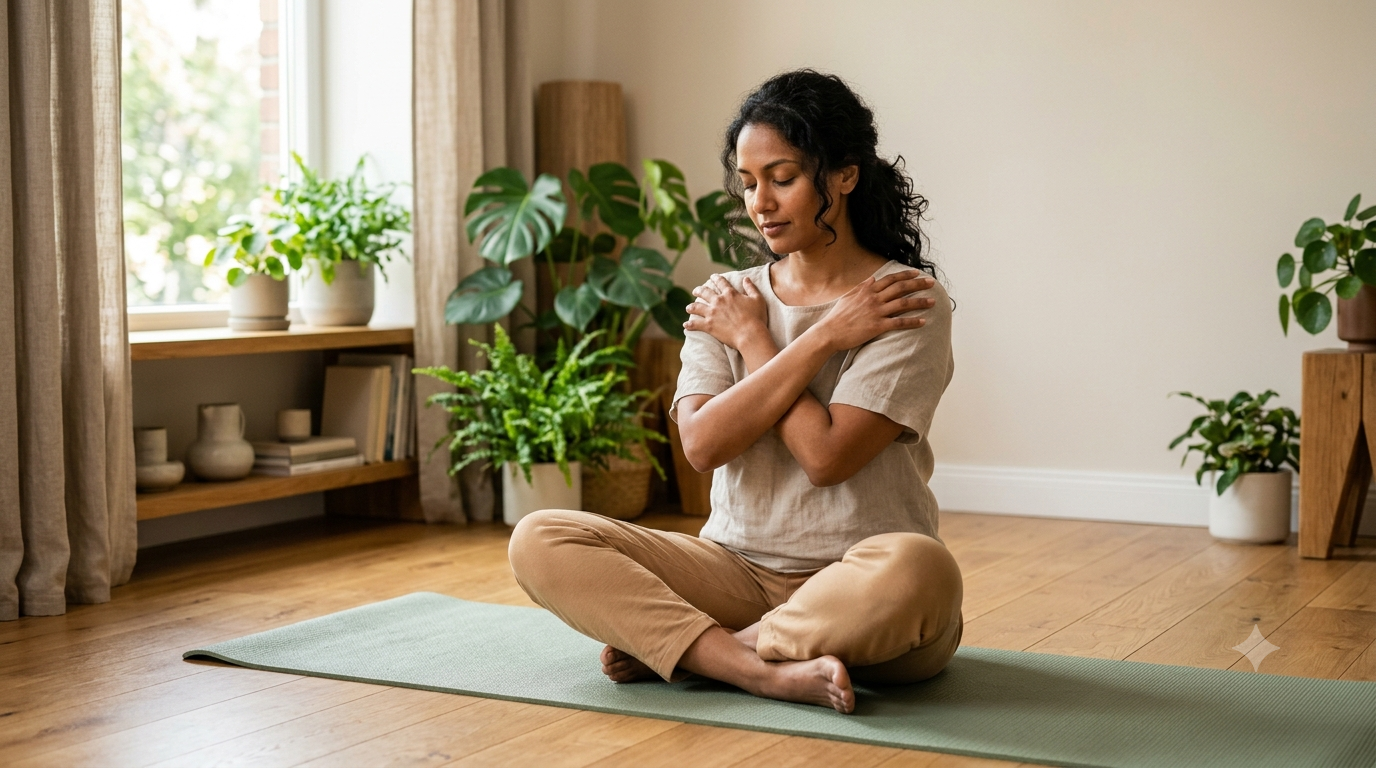
Cross your arms over your chest so each hand rests on the opposite upper arm or shoulder, like a light self-hug. Let the weight of your arms settle, breathe slowly, and if it feels right, add a very slight alternating press, left, then right, at a slow, calming pace. Stay for a minute or two.
The steady pressure and slow rhythm signal safety to the nervous system, a bit like the way a firm, reassuring hand can settle someone. It's one of the gentlest somatic exercises, which makes it a good choice when you feel fragile or overwhelmed and want something that asks nothing of you.
Grounding through the feet
When your attention is spinning up in your head, bringing it down into the body's contact with the ground is a fast, quiet reset.
Sit or stand and put your attention on the soles of your feet where they meet the floor. Feel the contact, the pressure, the temperature. Press your feet down gently and notice the ground pushing back. If it helps, slowly name a few things you can see and hear around you, letting your senses anchor you in the present.
This works by pulling attention out of anxious thought and into direct physical sensation, which interrupts the stress spin. Of these somatic exercises, grounding is the most invisible; you can do it in a meeting or a waiting room with no one aware, which makes it a reliable tool for public moments.
Slow, linked movement
Rounding out the set, gentle movement paired with breath lets the body release and settle at the same time, which is the heart of what makes yoga regulating.
You don't need a full practice. Slowly roll your shoulders and neck, reach your arms overhead on an inhale and lower them on a long exhale, or fold gently forward and rise back up with your breath. Move slower than feels natural and let the exhale lead. A few minutes is plenty.
Linking slow movement to a long exhale stacks two regulating inputs, physical release and parasympathetic breathing, which is why it settles the body so reliably. It's the most complete of these somatic exercises, and a natural one to end a short routine on.
Combining these somatic exercises into a short routine
You don't have to do all of these every time. But stacking a few in a sensible order makes a short, reliable routine you can lean on daily, and it's more effective than reaching for a single practice only when you're already in crisis.
Here's a two-to-three-minute sequence I often teach. Start with gentle shaking for thirty seconds to discharge restless energy and get out of a frozen or wired state. Then move to three or four rounds of the voo sound or audible sighing, to lengthen the exhale and bring the recovery branch online. Finish with a minute of grounding through the feet, or a self-hold if you feel scattered, to settle and land in the present.
That order works because it goes from more activating to more settling, which is how the body prefers to come down: discharge first, then quiet. If you only have thirty seconds, drop everything but the sighing. If you have five minutes, add the slow linked movement at the end. The point of building a routine from these somatic exercises is that repetition, not any single practice, is what retrains your baseline.
Do the sequence at the same time each day and your nervous system starts to recognize it, dropping into recovery faster each time. A morning version sets the tone for the day; an evening version helps you unwind toward sleep. Either way, the consistency is what turns a set of exercises into a lasting change.
Why body-based practices reach what talking can't
It's worth understanding why these work, because it explains when to reach for them instead of trying to talk yourself down.
When a nervous system is genuinely activated, the thinking mind is already downstream of the body's alarm. Trying to reason yourself calm in that state is like arguing with a smoke detector; the signal isn't coming from your thoughts, so your thoughts can't fully switch it off. Body-based practices work because they go straight to the source, feeding the nervous system the physical cues of safety it's actually built to respond to.
That's the quiet advantage these practices have over pure mindset work. A long, voiced exhale, a shake, a grounding of the feet, none of them require you to think differently first. They change the body, and the calmer body then makes clearer thinking possible. This is why people who feel stuck in their heads, or too activated to meditate, often find their way in through movement or sound when nothing cognitive was landing.
It's also why these tools are so useful for people who freeze or go numb under stress. For them, more thinking just deepens the shutdown, while a small physical action, standing up and shaking, pressing the feet into the floor, gives the system a way back online. Matching the tool to the state, rather than forcing one approach, is part of using these practices well. When words fail, the body still has doors.
A few honest cautions
These practices are gentle, but a couple of notes make them safer and more effective, especially if you carry trauma.
Go slowly and stay within what feels tolerable. If any exercise brings up strong distress rather than settling, ease off, return to simple grounding through the feet, and don't push. Body-based work can surface stored material, and more intensity is not better. For anyone with significant trauma, these somatic exercises work best alongside professional support, not as a replacement for it.
And remember that consistency, not intensity, is what changes your baseline. A minute or two of these done most days will retrain your nervous system far more than a long session done once when you're already in crisis. The mechanism behind why they work is in how nervous system regulation works, and the plain-language definition is in what is nervous system regulation.
Where to start
Somatic exercises are the most direct tools you have for nervous system regulation, because they speak to the body in its own language. Start with the voo sound or a few audible sighs, add shaking when you feel wired and a self-hold when you feel scattered, and ground through your feet whenever your mind spins up. None of it is complicated, and none of it requires anything but you.
Pick two of these and do them daily for a week. Keep them short, go gently, and let your body get past the early restlessness. The overview of why this layer matters is in nervous system regulation, and it's worth reading once you've felt these practices work, because the concept makes far more sense in a body that has experienced the shift.
How Coliberation brings somatic work to programs and teams
If you'd like these practices led by trained facilitators for a treatment program or a company, that's what my team does. Coliberation places certified, trauma-informed facilitators into treatment centers and workplaces for on-site and live-virtual sessions across breathwork, movement, guided meditation, and sound.
Here's the mechanism. You get a managed team, so a facilitator being out never cancels the session; a trained substitute in the same modality steps in. You get one point of contact and one invoice across every session and location.
Every facilitator is trauma-informed, certified, and insured, so the room stays safe, which matters especially with body-based work. And each session is matched to the group, because different people need different entry points. There's one more piece to how we keep quality consistent across a roster, and it's the first thing I'll walk you through on a call.
We run this work weekly inside mental health programs and have delivered it for groups like Kaiser Permanente. Picture your people with safe, guided somatic exercises they can carry into any hard moment.
Book a discovery call and tell me who you're serving. If we're a fit, I'll show you where to begin. If we're not, I'll tell you that too.
Warmly, Kara