If you've been told to regulate your nervous system and left wondering what that actually means in practice, this is the guide I wish more people got. Not the abstract version. The one that tells you what to do when your chest is tight and your mind is racing and you have four minutes before the next thing.
I've led thousands of these sessions inside treatment centers and companies, and I've watched what works land in real bodies. The good news is that the tools are simple. The catch is that the order and the consistency matter more than any single technique.
To regulate your nervous system, you shift your body out of its stress state and into its recovery state using direct, physical inputs: slow breathing with a longer exhale, calming sound, gentle movement, and, for some people, brief cold exposure. The key principle is to regulate first and solve problems second, and the key to lasting change is doing these practices consistently, not perfectly. Most people feel a difference in one session and a durable shift within a few weeks.
Here's how to do it, step by step, and what to expect along the way.
First, learn to notice you're activated
You can't regulate a state you haven't noticed. So the first skill isn't a technique at all; it's catching the moment your nervous system has revved up.
The body tells on itself if you listen. Activation shows up as shoulders creeping toward your ears, a tight jaw, shallow breathing high in the chest, a clenched stomach, gripped hands. Your thoughts speed up and narrow. You feel the pull to react right now.
Most people miss these signals for years because the state is so familiar it feels like their personality. Learning to regulate your nervous system starts with re-labeling that feeling as what it is: not "this is just how I am," but "my body is activated and I can help it come down."
Once you can catch it, you have somewhere to intervene. That noticing is half the work.
The one rule that makes everything else work: regulate first
Before any technique, absorb this principle, because it's the thing that turns tools into results. Regulate first, resolve second.
Almost everyone does it backwards. They try to solve the problem, win the argument, make the decision, resist the craving, while their body is still in fight-or-flight. From that state you get reactive, fear-based, compulsive choices, the ones you regret. A stressed body makes stressed decisions.
So the move is always the same. When you notice you're activated, you don't push to fix the situation yet. You regulate your nervous system first, and then you handle the thing from a settled state. The situation is still there in ninety seconds; you'll meet it better.
This isn't avoidance. It's sequencing. You're not skipping the problem, you're getting your body into the state that can actually solve it.
The most portable way to regulate your nervous system: slow breathing
If you learn one way to regulate your nervous system, make it the breath, because it's always with you and it works fast.
The mechanism is real, not mystical. When you slow your breathing and make the exhale longer than the inhale, you nudge the autonomic nervous system toward its recovery branch. Physiologically, the inhale mildly activates and the exhale reactivates the parasympathetic brake, so a longer out-breath is a direct signal to calm down. Slow breathing measurably raises vagally-mediated heart rate variability, a marker of that recovery state (systematic review and meta-analysis, Neuroscience & Biobehavioral Reviews, 2022).
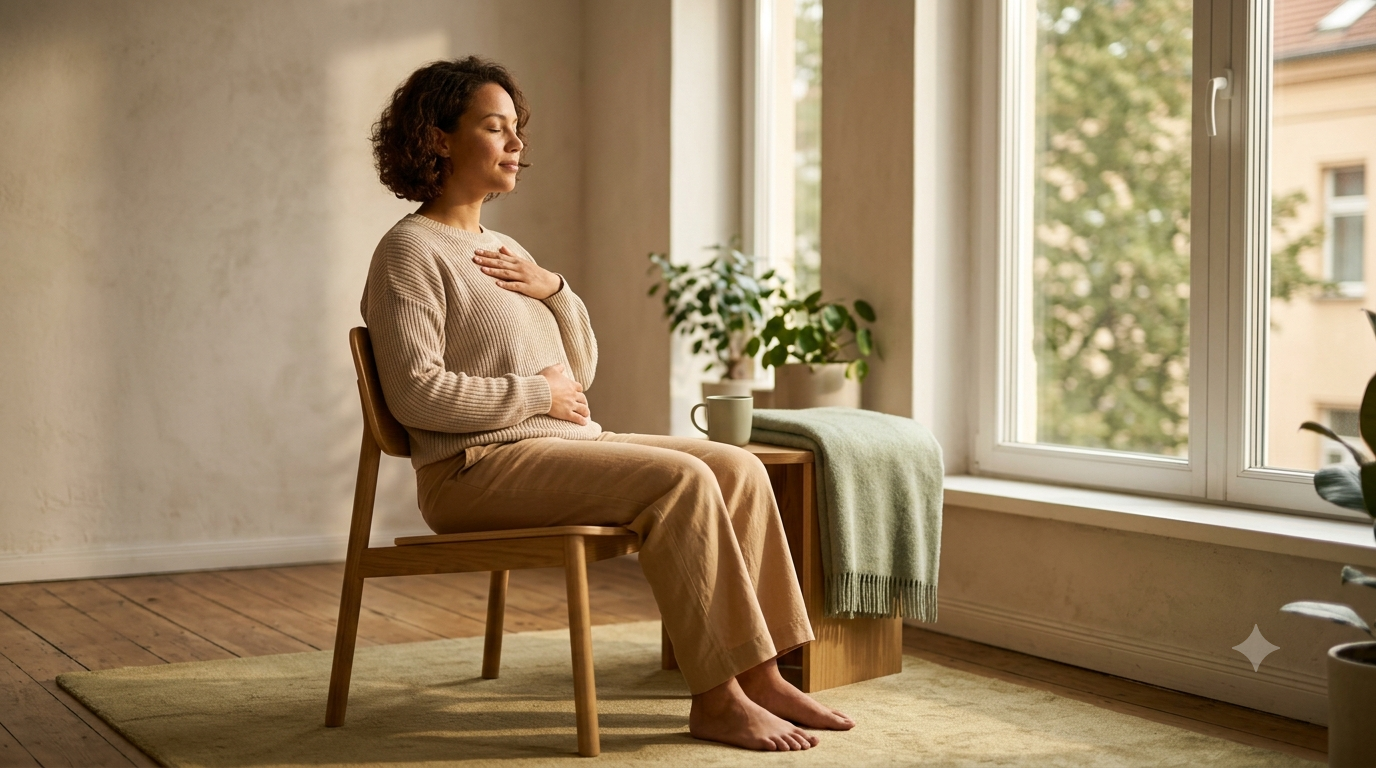
Here's how I coach it. Breathe in slowly through the nose for a count of about four, then let the exhale be longer and softer, a count of about six, as if you're fogging a mirror or gently sighing out. Let the belly move, not just the chest. Do that for even ninety seconds and most people feel the edge come off.
The audible exhale matters more than people think. A soft sighing sound on the out-breath, or a low "voo" tone as you exhale, adds to the calming effect. That vocal exhale comes from Somatic Experiencing, Peter Levine's body-based trauma work, and it gives the nervous system an extra cue that it's safe to settle.
Keep it undramatic. You're not hyperventilating or forcing anything. You're just lengthening the exhale and letting the body follow.
The easiest doorway: sound
Some days you don't have the focus to do breathwork "correctly," and that's exactly when sound helps, because it asks nothing of you.
In a sound session, whether it's singing bowls, chimes, or a recorded soundscape, you don't have to perform or concentrate. The tones do the work, carrying your system toward rest while you simply lie there and receive. For people who find stillness or focused breathing threatening, and that includes a lot of chronically activated people, sound is the gentlest way to regulate your nervous system.
You can recreate a smaller version of this at home. Put on a slow, wordless soundscape or a single sustained tone, use headphones, close your eyes, and let your attention rest on the sound rather than your thoughts. It's a low-effort entry point on the days effort is exactly what you don't have.
The release valve: gentle movement
When tension is stuck in the body, movement gives it somewhere to go. We hold our issues in our tissues, and sometimes you have to move to let them out.
This doesn't mean an intense workout. To regulate your nervous system, the movement that helps most is gentle and a little primal: slow stretching, rolling the shoulders and neck, or literally shaking, letting your hands, arms, and legs tremble loosely for thirty seconds the way animals shake off stress. It feels strange the first time and then it feels like relief.
Gentle yoga does the same thing with more structure, pairing movement with breath so the body discharges tension and settles at the same time. If you feel numb, frozen, or wired-but-stuck, movement is often what gets your system online enough that breathing and sound can then bring it down.
The advanced tool: brief cold, with real cautions
Cold exposure has gotten popular, and it does train the nervous system, but it's the one tool I'd tell you to be careful with.
Brief cold, a cold rinse at the end of a shower, or water around 55 to 60 degrees, works like weightlifting for the nervous system. It's a manageable stressor that teaches your system to stay composed under pressure and then recover, and research shows cold exposure shifts the autonomic system toward parasympathetic recovery afterward (systematic review and meta-analysis, Journal of Thermal Biology, 2024).
Here's the honest caution. Cold is not for everyone. I don't recommend it for people in recent trauma, anyone whose nervous system is already overactive, or anyone with a heart condition, because the same stress that trains a stable system can flood a fragile one. If that's you, skip it entirely and stay with breath, sound, and movement. If you do try cold, keep it brief and always finish by breathing slowly to bring yourself back down.
What to expect, and why consistency is everything
Here's the part most guides leave out, and it's the part that determines whether any of this works: what the first few weeks actually feel like.
When a chronically activated person first tries to regulate your nervous system on purpose, the early sessions can feel restless, even irritating. Stillness is unfamiliar to a revved system, so it protests. This is completely normal, and it is not a sign that you're doing it wrong or that it won't work for you.
Then, usually around three sessions in, something turns over. The parasympathetic recovery response kicks back into gear, and the practices start to feel good instead of forced. Your body remembers how to rest. From there it compounds: sleep improves, reactivity drops, and the settled state gets easier to reach.
That's why consistency beats intensity every time. A short practice done daily teaches your nervous system to trust the reset far more than a long one done once. Five minutes of breathing every morning will change more than an hour-long session you do once a month. The body learns regulation through repetition, so pick something small enough that you'll actually keep doing it.
Doing it alone versus with a guide
You can absolutely practice on your own, and you should. But it's worth naming why guided sessions work so well, because it explains a common frustration.
Left to willpower alone, most people don't sustain a solo practice; life gets busy and the habit fades. A guided session removes the willpower problem. Someone else holds the time and the container, so you just show up and follow. That's why a regular class or a facilitated session at work often works when a solo app didn't.
A guide also helps you feel the target. Until you've experienced a genuinely settled nervous system, it's hard to know what you're aiming for. Once a good session shows your body what regulated feels like, your solo practice suddenly makes sense, because now you know the destination. If you want that guided experience without leaving your desk, virtual sessions are a simple place to start.
For the underlying map of all of this, see nervous system regulation, the overview of why this layer matters. For a fuller menu of tools ranked by effort, see nervous system regulation techniques. And if you want the physiology in more depth, how nervous system regulation works explains the mechanism.
Putting it together: a simple five-minute sequence
If you want a concrete routine to start with, here's one I teach that stacks the tools in a sensible order.
Begin by naming your state. Take ten seconds to notice where you're activated: the shoulders, the jaw, the breath. Don't fix anything yet, just register that your body is revved. Then give yourself two minutes of slow breathing, inhale for about four, exhale softly for about six, adding a quiet sigh on the way out. Let the belly move.
From there, add thirty seconds of gentle movement: roll the shoulders, shake out the hands and arms, let the body loosen. Finish with a minute of stillness, eyes closed, resting your attention on any calming sound around you or on the feel of the breath. That's it. Five minutes, no equipment, and it hits the nervous system from three angles at once.
Do that sequence at the same time each day, first thing in the morning is ideal, and you'll teach your body to regulate your nervous system on cue. The routine matters less than the repetition. Once it's a habit, you can shorten it to whatever you have time for and still get the benefit.
Where to start
The honest headline is that learning to regulate your nervous system isn't complicated, it's just unfamiliar. Notice when you're activated, regulate before you try to solve anything, and use the simplest tool you have: a longer exhale, a calming sound, a little movement. Keep it small and do it often.
Pick one practice and do it daily for a week. Don't judge the early restlessness; that's just your system learning. Give it a few sessions and let your body show you what settled feels like. Once you know that feeling, you'll be able to find your way back to it anywhere.
How Coliberation helps people and teams regulate
If you'd rather learn this with a guide, or bring it to a treatment program or a team, that's what my team does. Coliberation places certified, trauma-informed facilitators into treatment centers and companies for on-site and live-virtual sessions across breathwork, guided meditation, movement, and sound.
Here's the mechanism. You get a managed team, so a facilitator being out never cancels the session; a trained substitute in the same modality steps in. You get one point of contact and one invoice across every session and location.
Every facilitator is trauma-informed, certified, and insured, so the room stays safe. And each session is matched to the people in it, because different groups need different entry points. There's one more piece to how we keep quality consistent across a roster, and it's the first thing I'll walk you through on a call.
We run this work weekly inside mental health programs and have delivered it for groups like Kaiser Permanente. Picture your people with a reliable way to come back down, led by someone who knows how to hold the room.
See our Virtual sessions or book a discovery call and tell me who you're trying to help regulate your nervous system, whether that's a clinical group, a leadership team, or a whole company. If we're a fit, I'll show you where to begin. If we're not, I'll tell you that too, because the wrong program helps no one.
Warmly, Kara